



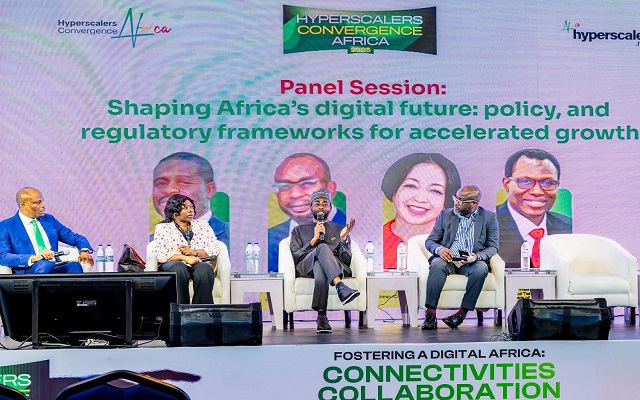
The Director General of the National Information Technology Development Agency (NITDA), Kashifu Inuwa Abdullahi, has urged stronger collaboration, innovation, and inclusive policymaking to position Africa as an AI-ready continent.
Speaking at the Hyperscalers Convergence Africa 2025 in Lagos, themed “Fostering a Digital Africa: Connectivities, Convergence and Innovation,” Inuwa said Africa’s youthful population remains its greatest asset, provided the right skills and structures are in place.
“We have a generation that is energetic and curious about technology. Our task is to equip them with digital and technical skills to transform this demographic advantage into a digital dividend,” he said, citing NITDA’s 3 Million Technical Talent (3MTT) programme as a key initiative in that direction.
He noted that the Federal Government, under President Bola Ahmed Tinubu, is mobilising public and private investments to expand digital infrastructure through initiatives such as the PPP Policy on Mediation and Project Bridge. The government, he added, is also developing a Digital Public Infrastructure framework to connect identity, payments, and data systems for AI-powered services.
Inuwa stressed the need for Africa to leverage local data and homegrown talent to develop AI systems suited to its realities, warning against dependence on foreign models. “During the industrial revolutions, Africa supplied raw materials but gained little technological value. We must not repeat that mistake,” he said.
At another session on digital policy, Inuwa called for practical, inclusive, and scalable approaches to innovation. “Policymaking must be collaborative and data-driven. You can’t design effective policies without involving the builders,” he said, highlighting NITDA’s Intelligent Regulatory Framework and Nigeria’s co-created National Artificial Intelligence Strategy as examples of inclusive, adaptive governance.
“When we talk about Africa’s growth, we must also think in the same ecosystem mindset. In the technology space, we often speak of the Nigerian tech ecosystem, the African tech ecosystem, and the global tech ecosystem. This shows that no one can succeed in isolation. Technology doesn’t respect borders or hierarchies; it connects and transforms.”
He added that as Africa builds its systems, they must be designed to solve immediate challenges while keeping the bigger picture in mind. “The solution you create to solve a problem in your village or city can scale up to serve your state, your country, the continent, and even the world. That’s how every major tech company began. Facebook, for instance, started as a small project to connect students but today connects billions globally.”
He urged African countries to reinvent their social contracts through inclusive, data-driven, and collaborative policymaking.
