



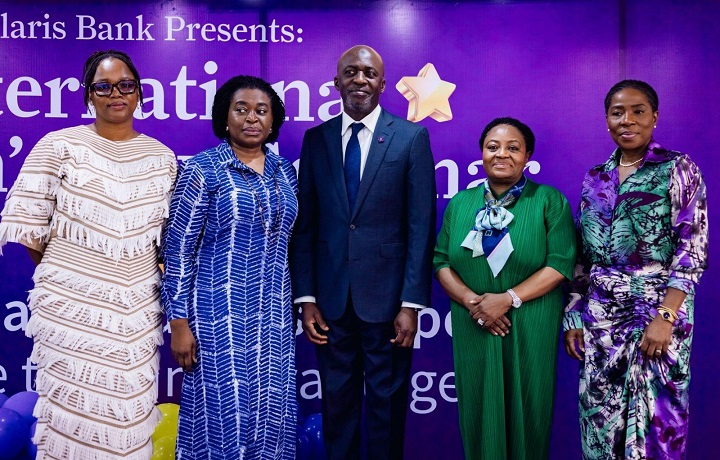
News Highlights:
- At its 2026 IWD forum, Polaris Bank positioned investment in women, through financing, leadership development, and inclusion, as a data-driven engine for innovation, productivity, market expansion, and long-term institutional resilience.
- Beyond advocacy, Polaris Bank showcased concrete outcomes, including over ₦1 billion in funding to female entrepreneurs, tailored programs like Polaris Pearl and Women Connect, and support for health and education.
Polaris Bank used its 2026 International Women’s Day (IWD) forum to position gender equity not as a corporate social obligation, but as a strategic lever for sustainable growth.
The bank highlighted its long-term investments in women’s empowerment, financial inclusion, and leadership pipelines as evidence that advancing women’s participation strengthens institutional performance and economic resilience.
Anchored on the theme, “Give to Gain,” the event framed generosity, collaboration, and deliberate investment in women as practical pathways to faster progress on equality. Speakers stressed that purposeful support for women creates multiplier effects that benefit businesses, families, and communities alike.
Managing Director/CEO Kayode Lawal reinforced this perspective, describing the sub-theme, “Gender Equity as a Business Imperative: The Give to Gain Advantage,” as a data-backed strategy rather than a symbolic gesture.
He emphasized that organizations that invest in women consistently realize tangible returns — from innovation and productivity to broader market growth.
According to Lawal, empowering women remains a core pillar of Polaris Bank’s long-term strategy, reflected in its support for women-led businesses through targeted financing, enterprise advisory, and capacity-building initiatives.
The Polaris CEO also highlighted the Bank’s sustained advocacy for breast cancer screening and early detection, as well as its contributions to girl-child education and inclusive workplace policies.
He added that the Bank’s flagship proposition, Polaris Pearl, continues to provide tailored financial solutions and growth platforms for women professionals and entrepreneurs.
He called for more deliberate action across sectors, stressing that inclusive systems ultimately drive stronger institutions and societies.
Delivering keynote insights, Tomi Somefun, the immediate past MD/CEO of Unity Bank, described gender equity as a critical lever for organizational performance, urging institutions to move beyond rhetoric to structured action.
She emphasized that enabling women to contribute fully is not a social obligation but a pathway to better decision-making, innovation, and long-term resilience.
Also speaking, Belinda Nkechi Indinmachi, a social entrepreneur, challenged the GenZs to adopt a more strategic approach to value creation, noting that purposeful contribution and long-term thinking are essential for sustainable career and business growth.
She encouraged professionals to view “giving” as an investment that yields tangible returns over time.
In her remarks, Polaris Bank’s Executive Director, Corporate & Investment Banking, Abimbola Ozomah, reiterated that the Bank’s focus on women empowerment extends beyond symbolic observance.
She noted that initiatives such as the Polaris Women Connect platform are deliberately designed to prepare female professionals for leadership through mentorship, knowledge-sharing, and exposure to industry leaders.
Earlier, Bukola Oluyadi, Group Head, Customer Experience & Value Management, set the tone for the engagement, highlighting the importance of collaboration and intentional support systems in driving collective success.
The event also showcased Polaris Bank’s measurable impact in advancing women’s economic participation, including the disbursement of over ₦1 billion in funding to female entrepreneurs, alongside continued investments in financial literacy and enterprise development.
Polaris Bank reaffirmed its commitment to empowering women, anchored in deliberate action and inclusive growth strategies that position women as key drivers of economic transformation.
