



News Highlights:
- Sterling Bank emphasised that financing women-led businesses must go beyond capital, integrating capacity building, networks, and institutional support to drive sustainable growth and resilience.
- With Nigerian women facing an estimated $42 billion financing gap, the OneWoman initiative is actively bridging this divide, disbursing ₦43.9 billion to 2,450 women in 2025 and targeting ₦500 billion for one million women by 2030.
Sterling Bank has shifted the conversation on women’s economic empowerment from rhetoric to results, convening key stakeholders to advance practical solutions for financing women-led businesses in Nigeria.
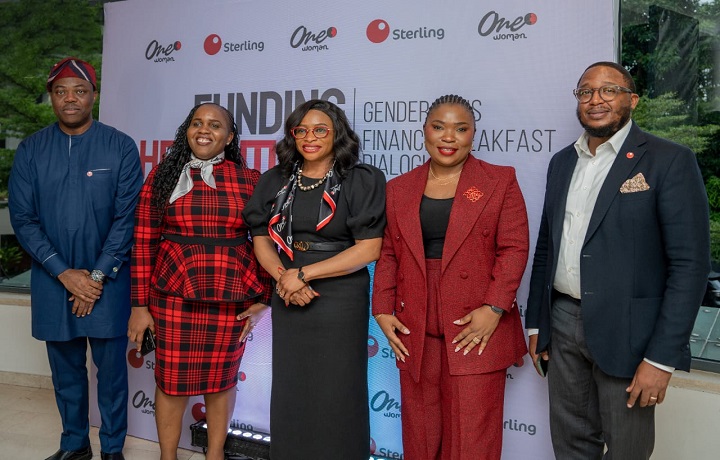
Through its women-focused initiative, OneWoman, the bank hosted entrepreneurs, development finance institutions, ecosystem leaders, and business stakeholders at the Funding Her Future Breakfast Dialogue in Lagos.
The gathering served as a strategic platform to interrogate not just access to capital, but the broader systems required to sustain and scale women-led enterprises.
At its core, the dialogue moved beyond funding as a standalone issue, emphasising the need for an integrated approach, one that aligns financing with business readiness, ecosystem support, and institutional collaboration to drive long-term growth and resilience.
Speaking at the event, the Managing Director and Chief Executive Officer of Sterling Bank, Abubakar Suleiman, noted that the gathering was designed to move beyond intention and into action.
“Today is about going further. It is about turning shared belief into shared action,” he said.
In his welcome remarks, delivered on his behalf by the Chief Growth Officer, Edward Ogunmekan, Suleiman described the dialogue as a convergence of finance, enterprise, inclusion, and sustainable economic growth.
“We are honoured to host such a distinguished gathering of partners, investors, women entrepreneurs, and business leaders, all brought together by one important question: How do we expand access to meaningful finance for women-led businesses in a way that is scalable, sustainable, and commercially sound?”
He explained that the conversation reflects a long-standing conviction at Sterling Bank—that real prosperity is built by backing people, ideas, and high-potential sectors. This philosophy, he noted, underpins the OneWoman initiative.
According to him, OneWoman was designed around three core pillars: capital, capacity, and community—recognising that finance alone is insufficient to unlock the full potential of women entrepreneurs.
“Women-led businesses need the right support systems, the right networks, and the right ecosystem to grow with confidence and scale with resilience,” he said.
The event also featured two panel sessions with representatives from funding institutions, women-focused organisations, entrepreneurs, and ecosystem partners. These sessions provided practical insights into available financing opportunities, while also examining the structural support required for sustainable enterprise growth.
Adding data-driven context to the discussion, Ezinne Nwokafor, Head of the OneWoman Initiative, underscored the urgency of closing Nigeria’s gender financing gap.
She noted that a significant majority of Nigerian women remain excluded from formal credit systems, with only a small percentage able to access structured financing. Despite gains in financial inclusion, systemic barriers continue to constrain women’s access to capital.
Nwokafor highlighted that women account for a substantial portion of micro, small, and medium enterprises and contribute significantly to the economy, yet face an estimated $42 billion annual financing gap, according to the International Finance Corporation.
She further referenced data indicating that more than half of women-led businesses identify access to finance as a major constraint, while loan rejection rates remain disproportionately higher for women than for men.
According to her, these challenges are rooted in structural factors, including disparities in asset ownership, restrictive social norms, and limited access to financial data and visibility.
Despite this, she maintained that the opportunity remains vast.
“Sterling’s OneWoman initiative is positioned to bridge this gap by combining financial solutions, mentorship, capacity building, and community support for women across different stages of their journey,” she said.
She revealed that in 2025 alone, the initiative disbursed N43.9 billion in loans to 2,450 female entrepreneurs, trained 6,000 women, and reached approximately 380,000 beneficiaries across its three focus segments—career women, women in business, and freshers. Looking ahead, the initiative aims to disburse N500 billion in loans to one million women by 2030.
Also speaking, Akporee Idenedo, Divisional Head of Commercial Banking, reaffirmed Sterling Bank’s commitment to addressing the challenges raised during the dialogue. He emphasised that capacity building and skills development will remain central to building a resilient and sustainable ecosystem for women entrepreneurs.
The Funding Her Future Breakfast Dialogue forms part of Sterling Bank’s broader strategy to deepen support for women through targeted financing, enterprise development, and community-driven growth.
Through OneWoman, the bank continues to expand platforms and solutions that empower women to build sustainable businesses, create jobs, and play a more significant role in driving economic progress.
