



News Highlights:
- NITDA advocates digital sovereignty and indigenous AI development
- Stakeholders emphasise responsible AI governance and implementation
The quest to position Nigeria as a leading force in Africa’s emerging artificial intelligence (AI) ecosystem took centre stage in Abuja as the National Information Technology Development Agency (NITDA) called for a decisive shift from technology consumption to indigenous innovation and responsible AI development.
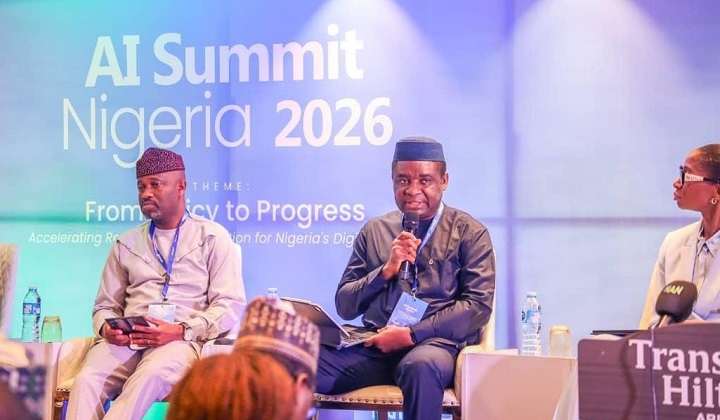
Speaking at the AI Summit Nigeria 2026, hosted by Microsoft, NITDA’s Director-General, Kashifu Inuwa, underscored the imperative of digital sovereignty, insisting that Nigeria and the broader African continent must actively shape the future of artificial intelligence rather than merely adapt to technologies developed elsewhere.
Represented by Barr. Emmanuel Edet, NITDA’s Acting Director of Regulation and Compliance, Inuwa, described artificial intelligence as a transformative force with the potential to revolutionise every sector of the economy. He, however, stressed that responsible adoption anchored on trust, accountability and transparency remains critical to unlocking AI’s full potential.
“Without public trust, AI adoption will be stalled,” Inuwa noted. “Without accountability, innovation will not scale sustainably, and without transparency, citizens will lose confidence in the systems designed to serve them.”
The summit, themed “From Policy to Progress: Accelerating Responsible AI Adoption for Nigeria’s Digital Decade,” was jointly organised by Microsoft, NITDA and MTN. It brought together key stakeholders from both the public and private sectors to develop practical pathways for integrating AI into Nigeria’s economic landscape.
A major highlight of Inuwa’s address was the call for genuine digital sovereignty. He urged Nigeria to transition from being largely dependent on foreign technologies to becoming a producer of AI solutions tailored to local realities.
“We must become creators of intelligence rooted in our realities and responsive to our aspirations,” Inuwa urged. “We must build local talent, strengthen research ecosystems and create an enabling environment where Nigerian and African solutions can thrive.”
He further maintained that Africa must assume a defining role in shaping the global AI agenda rather than simply responding to innovations developed elsewhere.
Also speaking at the summit, Microsoft’s Director of Government Affairs for West Africa, Nonye Ujam, commended Nigeria for its proactive approach to AI governance, particularly through the National AI Strategy and ongoing regulatory reforms.
She nevertheless challenged stakeholders to move beyond policy formulation and accelerate the implementation of AI solutions capable of delivering tangible benefits to citizens, businesses and government institutions.
Ujam emphasised that sustainable AI adoption depends on strong governance structures, adequate infrastructure and institutional capacity, while ensuring that innovation remains grounded in the principles of fairness, security, transparency and accountability.
The summit stimulated robust discussions on regulatory clarity, digital sovereignty, and the need to strike a balance among innovation, collaboration, and strategic control within Nigeria’s rapidly evolving technology ecosystem.
Key institutions, including the Nigeria Customs Service, the National Identity Management Commission and Galaxy Backbone, participated actively in the discussions, signalling a broad-based commitment to advancing Nigeria’s digital future.