



Honorary degrees often celebrate remarkable careers. They acknowledge years of excellence, innovation, leadership, and service. Yet, only on rare occasions do they become the platform for unveiling a transformative vision capable of reshaping the future of an institution—and perhaps even an entire sector.
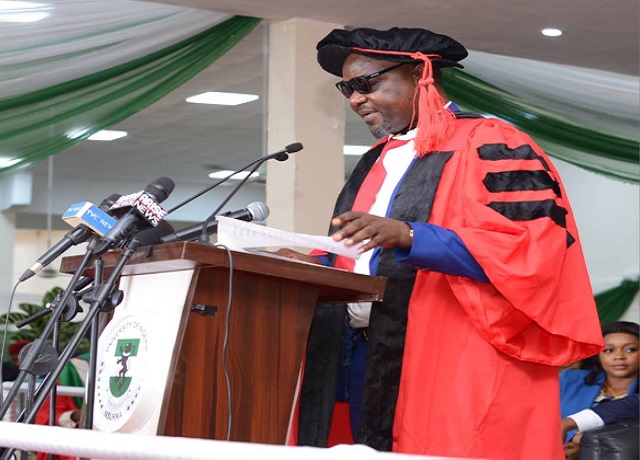
That was precisely what unfolded at the 54th Convocation Ceremony of the University of Nigeria, Nsukka (UNN), where architect, industrialist and technology entrepreneur, Arc. Dr. Kaycee Orji, received the prestigious Honorary Doctor of Business Administration (Honoris Causa).
While the conferment recognised his outstanding contributions to industrial development, manufacturing, entrepreneurship, innovation and nation-building, the ceremony quickly evolved into something far more consequential. It became the launchpad for a bold proposition that could reposition UNN as one of Africa’s foremost centres for emerging technologies.
At the heart of that vision is the proposed Dr. Kaycee Orji Centre for Artificial Intelligence, Smart/Green Mobility and Digital Innovation, an ambitious initiative designed not merely to establish another university research facility, but to redefine how African universities generate knowledge, develop talent and drive economic transformation.
A Vision Beyond Recognition
The honorary doctorate was conferred by the Chancellor of the University, His Imperial Majesty, Oba Adeyeye Enitan Ogunwusi, Ojaja II, CFR, the Ooni of Ife, alongside the Pro-Chancellor and Chairman of the Governing Council, Professor Adegboyega Adebayo Karim, and the Vice-Chancellor, Professor Simon Uchenna Ortuanya.
Receiving the honour, Dr. Orji described it as “not merely a recognition of past accomplishments, but a call to greater service.”
His remarks reflected a philosophy increasingly shared by leading innovators worldwide, that the greatest impact of leadership lies not in personal achievement but in building institutions capable of producing lasting value.
“Every honour carries with it a greater responsibility. This recognition strengthens my resolve to continue investing in ideas, people and institutions that can shape a better future for our nation and our continent,” he said.
That commitment found practical expression in his announcement of the proposed AI and Smart Mobility Centre.
More Than a Research Centre
Artificial Intelligence is no longer regarded as a futuristic concept. It is rapidly becoming the defining technology of the Fourth Industrial Revolution, transforming industries ranging from healthcare and finance to agriculture, manufacturing, education and transportation.
Likewise, smart and green mobility technologies, including electric vehicles, autonomous systems and intelligent transport infrastructure, are redefining how societies move people and goods while addressing environmental sustainability.
For Africa, these technologies present both an opportunity and a challenge. The opportunity lies in leapfrogging traditional stages of industrial development by embracing digital innovation. The challenge is ensuring that African institutions produce not only consumers of these technologies but also creators, researchers and entrepreneurs capable of developing homegrown solutions.
It is within this context that Dr. Orji’s proposal assumes strategic importance.
Rather than creating another academic department or conventional research institute, the Centre is envisioned as a multidisciplinary innovation ecosystem where academia, industry, government and entrepreneurs converge to solve real-world problems.
Its focus extends beyond theoretical research to practical innovation, commercialisation of ideas and enterprise creation.
As Dr. Orji aptly observed: “The greatest legacy we can leave the next generation is not simply another building, but an institution that inspires ideas, nurtures innovation and transforms research into practical solutions that improve lives.”
That statement encapsulates the emerging global philosophy of higher education; universities must increasingly become engines of innovation rather than mere producers of graduates.
Bridging the Gap Between Academia and Industry
One of the long-standing criticisms of African higher education has been the disconnect between university research and industrial application. Thousands of research projects are completed annually across Nigerian universities, yet relatively few progress beyond academic journals into commercially viable products or services.
The proposed Centre seeks to bridge that gap. Its design places equal emphasis on research, entrepreneurship, product development, skills acquisition and technology commercialisation.
The planned specialised laboratories, including Artificial Intelligence and Machine Learning, Smart and Green Mobility Technologies, Robotics and Internet of Things (IoT), Digital Finance and Financial Technology, and Cloud Computing and Advanced Data Infrastructure, reflect sectors expected to drive the global economy over the coming decades.
These facilities could provide students and researchers with opportunities to work on practical industry challenges while collaborating with technology companies, manufacturers, investors and policymakers.
If successfully implemented, the Centre would create an environment where ideas move seamlessly from laboratory research to startup incubation, industrial application and commercial success.
Creating Africa’s Next Generation of Technology Entrepreneurs
Perhaps one of the most significant aspects of Dr. Orji’s proposal is the establishment of the Kaycee Orji Founders Innovation Challenge. Across the world, innovation competitions have become powerful mechanisms for identifying young talent, supporting early-stage entrepreneurs and accelerating technology startups.
The annual programme is expected to identify exceptional ideas from students and researchers, provide mentorship, facilitate industry partnerships and support commercialisation. Such initiatives are increasingly recognised as essential components of modern innovation ecosystems.
Rather than waiting until graduation to seek employment, students would be encouraged to become innovators capable of creating companies, generating employment and developing technologies with global relevance.
This represents a shift from traditional education models towards entrepreneurial universities—institutions that actively stimulate economic growth through innovation.
Positioning UNN on Africa’s Innovation Map
The University of Nigeria has historically maintained a reputation as one of the continent’s pioneering institutions. Established with a vision of producing graduates equipped to solve Africa’s development challenges, UNN has consistently contributed significantly to Nigeria’s academic landscape.
The proposed AI and Smart Mobility Centre presents an opportunity to strengthen that legacy. Beyond attracting researchers and students, such a facility could position the University as a destination for international research partnerships, technology investments and interdisciplinary collaboration.
Globally, universities that host advanced innovation centres often become magnets for venture capital, multinational technology companies, development agencies and research grants. This creates a virtuous cycle in which innovation attracts investment, investment strengthens research, and stronger research generates further innovation.
For UNN, the Centre could become both an academic asset and an economic catalyst.
Supporting Nigeria’s Digital Transformation Agenda
The timing of the proposal also aligns with Nigeria’s growing emphasis on digital transformation, artificial intelligence, local manufacturing and industrial diversification. Government policies increasingly encourage innovation, digital skills development and technology-driven economic growth.
Artificial Intelligence has emerged as one of the strategic priorities for national development, with growing investments in digital infrastructure, startup ecosystems and research capacity.
The proposed Centre, therefore, complements broader national ambitions by creating an institutional platform capable of developing the human capital required to sustain future technological advancement.
It also reinforces the importance of partnerships between academia and the private sector in achieving national development goals.
Building Institutions That Outlive Individuals
Throughout his acceptance address, Dr. Orji challenged African universities to redefine their mission. Rather than functioning solely as centres for awarding degrees, he argued that they must become engines of industrialisation, entrepreneurship and technological innovation.
“The future belongs to those who create solutions, not merely those who seek opportunities. Our universities must become places where ideas are transformed into enterprises, where research becomes industry and where innovation becomes national development.”
That philosophy perhaps explains why observers viewed the announcement of the Centre as the defining moment of the convocation.
While honorary degrees traditionally commemorate distinguished careers, Dr. Orji used the occasion to announce an initiative designed to outlive individual accomplishment. He disclosed that preliminary conceptual work had already commenced, with architectural and engineering designs being prepared by K.KH Contractors Ltd., a member of the ROXETTES GROUP.
A comprehensive proposal, he said, would be submitted to the University in the coming months to facilitate discussions on implementation, institutional collaboration and statutory approvals.
The project, he stressed, would be developed in partnership with the University to ensure alignment with its academic vision and long-term development objectives.
A Legacy Defined by the Future
Dr. Orji is widely recognised for championing investments across electric vehicle manufacturing, industrial production, construction, digital financial services and sustainable mobility through the ROXETTES GROUP.
Industry stakeholders have long associated his work with local manufacturing, technology transfer, youth empowerment and innovation-driven economic development. Yet, the significance of his honorary doctorate may ultimately rest less on the recognition itself than on the institutional legacy it inspired.
If realised, the proposed Dr. Kaycee Orji Centre for Artificial Intelligence, Smart/Green Mobility and Digital Innovation has the potential to become more than a university facility. It could catalyze a new model of higher education in Africa—one where universities are not simply repositories of knowledge but creators of industries, incubators of innovation and architects of national competitiveness.
As the curtain fell on UNN’s 54th Convocation Ceremony, one message resonated far beyond the celebration of an accomplished entrepreneur: the honorary doctorate recognised a lifetime of achievement.
The vision unveiled before the University community pointed unmistakably towards the future—a future in which artificial intelligence, smart mobility and innovation are not merely subjects of academic inquiry but the foundations upon which Africa’s next chapter of development will be built.