



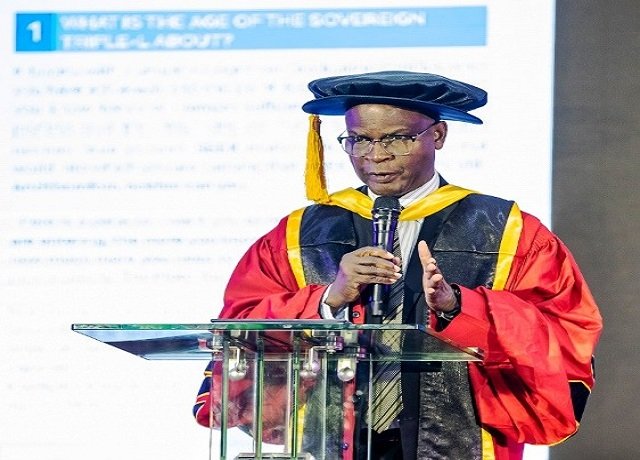
The President of the Accra Institute of Technology (AIT), Professor Clement K. Dzidonu, has called for a fundamental shift in how individuals and institutions perceive education, warning that university graduation can no longer be regarded as the end of a person’s learning journey.
Prof. Dzidonu said the rapid advancement of Artificial Intelligence (AI), emerging technologies and changing workplace demands had made continuous learning and capability development essential for anyone seeking to remain relevant in the modern economy.
He made the case for what he describes as the “Sovereign Triple-L” — the Sovereign Lifelong Learner, a concept that places responsibility for continuous personal and professional development squarely on the individual.
According to him, the conventional progression of acquiring knowledge in university, graduating, entering a profession and relying largely on previously acquired knowledge throughout one’s career is increasingly becoming unsustainable.
“You went to university. You acquired knowledge. You graduated. You entered a profession. And for many years, much of what you had learned remained relevant to what you were called upon to do. That world is disappearing,” he said.
Graduation Marks a New Learning Journey
Prof. Dzidonu noted that university qualifications would continue to play an important role in recognising an individual’s knowledge and achievements at a particular point in time.
However, he cautioned that a degree could no longer guarantee that the knowledge and capabilities acquired at graduation would remain adequate throughout a rapidly evolving career.
He therefore advocated a mindset in which graduation becomes the beginning of a new phase of learning, with individuals assuming greater responsibility for directing their own professional development.
“The Sovereign Triple-L is not simply someone who keeps taking courses, accumulates certificates, or waits until an employer sends them for training. The Sovereign Triple-L is a Sovereign Lifelong Learner — a person who takes ownership of continuing learning,” he said.
He explained that such an approach requires individuals to continually assess what they know, what they can do, what they need to learn, what they need to unlearn or relearn, where their capability gaps exist and what they must become capable of doing in the future.
The ‘SEEK-Gap’ in the AI Era
Prof. Dzidonu uses the acronym SEEK to describe an individual’s Skills, Expertise, Experience, Knowledge and Know-how.
He describes the “SEEK-Gap” as the constantly changing distance between the capabilities an individual currently possesses and those increasingly required to remain relevant, effective and professionally competent.
According to him, this creates a paradox he captures as: “The More You Know, the Less You Know.”
He explained that the statement does not suggest that acquiring knowledge reduces what a person knows. Rather, it reflects the continuous expansion of the frontier of what professionals can know, accomplish and are expected to deliver.
AI and other emerging technologies, he added, are accelerating this expansion by creating new professional practices, tools, challenges and opportunities, as well as new capability requirements.
The challenge, therefore, is not merely to accumulate more knowledge but to continuously transform evolving SEEK into Professional-SEEK-Capabilities — the integrated capabilities required to perform, solve problems, exercise judgement, adapt, innovate, collaborate, create and lead.
“The future will increasingly belong to those who remain capable of learning what tomorrow requires,” Prof. Dzidonu said.
Learning With AI Without Losing Human Agency
The AIT President also urged people to move beyond viewing AI primarily as a threat to existing knowledge, jobs and professional competencies.
Instead, he said, the technology should prompt individuals to reconsider what they learn, how they learn and how AI can be deployed to extend human capabilities.
“The more useful question is not merely, ‘Will AI make what I learned obsolete?’ It is: ‘How will I use AI, technology, experience, reflection and continuous learning to keep renewing what I know and what I am capable of doing?’”
He stressed that becoming a Sovereign Triple-L should not involve surrendering human judgement to AI.
Rather, individuals should learn with AI, while maintaining the capacity to question, challenge and responsibly deploy the technology.
He said people must simultaneously strengthen their ability to think independently, create, exercise sound judgement and continuously acquire new knowledge.
The emerging challenge, he added, is therefore not simply about confronting what people do not know, but developing the capacity to learn whatever changing circumstances demand.
‘See the Opportunity, Explore the Possibility, Create the Difference’
A central element of Prof. Dzidonu’s philosophy is the Opportunity–Possibility–Difference (OPD) Perspective, which he presents as a practical framework for lifelong learning and continuous capability development.
See the Opportunity
This involves recognising that change, emerging technologies, unfamiliar assignments, mistakes, challenges and disruptions can provide opportunities for learning, adaptation and personal growth.
Explore the Possibility
The next step is to examine what new skills, expertise, experiences, knowledge, know-how and capabilities can emerge from those opportunities.
Create the Difference
The ultimate objective of continuous learning, Prof. Dzidonu explained, is to convert knowledge and capability into value by solving problems, improving lives, strengthening organisations and communities, and creating meaningful impact in society.
The Sovereign Triple-L philosophy therefore extends beyond the pursuit of additional academic qualifications. It advocates a continuous process of transforming learning into capability and capability into measurable impact.
Lifelong Learning Beyond University Graduates
Although the concept is framed partly around university graduation, Prof. Dzidonu said the Sovereign Triple-L mindset should not be restricted to graduates.
He said it was increasingly relevant to students, professionals, entrepreneurs, educators, business leaders, institutions and anyone seeking to remain capable and relevant in a rapidly changing environment.
“What made an individual capable yesterday may not necessarily be sufficient tomorrow,” he said.
According to him, the appropriate response to technological change should neither be fear nor passive dependence on technology, but a commitment to continuous learning, capability development and personal responsibility for one’s evolution.
‘Never Stop Learning. Never Stop Becoming’
Prof. Dzidonu’s philosophy ultimately reframes graduation as a transition rather than an endpoint.
“Do not allow graduation to become the end of your learning journey. Let it become the beginning of a new one.”
The Sovereign Triple-L concept, he said, represents a call for individuals to develop a new relationship with learning—one that places continuous ownership of personal capabilities at the centre of professional growth and prepares people to meet the demands of an increasingly technology-driven future.
