



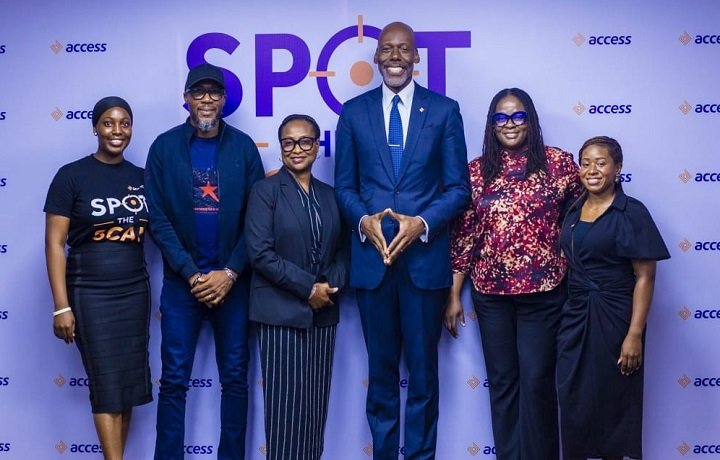
Four secondary schools have emerged as finalists in Access Bank Plc’s Spot the Scam Debate Competition, an initiative aimed at equipping young Nigerians with the knowledge and skills to recognise financial fraud and protect themselves against emerging scams.
The finalists — Keke Senior High School, British International School, CIS Lagos and Vetland Senior Grammar School — secured their places after emerging from a field of 12 schools that participated in the semi-final stage. The competition initially attracted over 100 schools before the selection process narrowed the field.
Speaking at the semi-final event in Lagos yesterday, Inyang Etim, Head of Regulatory and Financial Crimes Compliance at Access Bank, said the initiative was designed to educate young people on how to identify financial crimes, avoid falling victim to fraud and resist being recruited into fraudulent activities.
She identified requests for one-time passwords (OTPs) and personal identification numbers (PINs), fake bank upgrade messages and romance scams as some of the common tactics employed by fraudsters to deceive unsuspecting victims.
“The purpose is to teach the younger generation how to do business the right way and how to spot financial crimes, so that they are not victims,” Etim said.
She explained that the bank had invested in customer education to raise awareness about financial risks, stressing that customers must remain vigilant when handling sensitive banking information.
“The bank will never ask you for your OTP or your PIN,” she said.
Etim also emphasised that customers have a responsibility to safeguard their accounts, noting that the bank examines individual fraud cases to establish whether customers took the necessary precautions to protect their financial information.
Demonstrating how the competition could translate into wider awareness beyond the participating schools, Ajenifuja Abdulrasheed of Keke Senior High School said his team planned to turn the knowledge acquired into sustained anti-fraud campaigns within and outside the school environment.
He said the school intended to mobilise its debate team as ambassadors who would educate fellow students through assemblies, practical examples and social media engagements.
“When we return to school, our immediate step is to turn our debate team into ‘Spot the Scam’ Ambassadors with a duty to host short, relatable assembly programmes using real-life case studies,” he said.
“Young people do not like to listen to long lectures. They prefer to listen to their peers.”
Abdulrasheed also called for stronger technological safeguards by financial institutions to identify suspicious transactions and prevent fraud before substantial losses occur.
He advocated real-time alerts for unusual transfers and the integration of scam detection features into banking applications, arguing that fraudsters often move stolen funds rapidly across multiple accounts.
“Most fraudsters try to empty the account in seconds by sending money to other accounts,” he said.
Beyond technology, he urged banks to extend financial crime awareness campaigns to markets and motor parks, using local languages to communicate anti-fraud messages to a wider population. He also proposed the establishment of anti-fraud clubs in secondary schools to sustain financial literacy and encourage peer-to-peer learning.
Also speaking, Adedunni Ojoade, Head of Quality Assurance Team in Compliance at Access Bank, said the competition deliberately focused on teenagers between the ages of 12 and 16 because of their growing exposure to social media, digital platforms and potential financial scams.
“Before they get into university, let us catch them young and train them now, because this is the future of Nigeria,” she said.
Ojoade explained that the bank measures the effectiveness of its financial crime awareness programme through pre-training and post-training assessments conducted on its online platform. The assessments enable the bank to compare students’ knowledge before and after the exercise.
She added that the public debate sessions provide another opportunity to evaluate how well participants understood the lessons and their ability to apply the knowledge in discussing real-life financial crime issues.
The semi-final contest featured debates on three subjects: whether promoters of fraudulent schemes should be prosecuted, whether technology creates more opportunities for financial crimes than it does for crime prevention, and whether the desire for wealth is the primary motivation behind financial crime.
The eight other schools that participated in the semi-finals were Sonmori Senior Comprehensive High School, Ajara Senior Grammar School, Badagry; Abibat Mogaji Millennium Senior Secondary School; Ikeja Senior High School; Our Lady of Apostles Secondary School, Yaba; Holy Child College; St Kizito’s College; and Dansol High School/Dansol Christian Mission.
Ojoade disclosed that Access Bank had informed the Economic and Financial Crimes Commission (EFCC), the Central Bank of Nigeria (CBN) and the Nigerian Financial Intelligence Unit (NFIU) about the initiative.
She also acknowledged the support of the Lagos State Ministry of Education, which facilitated the bank’s access to government-owned secondary schools for the programme.
The grand finale will bring together the four successful schools in the concluding stage of the competition, which seeks to promote financial literacy, responsible financial behaviour and greater awareness of the tactics used by fraudsters among young Nigerians.
