



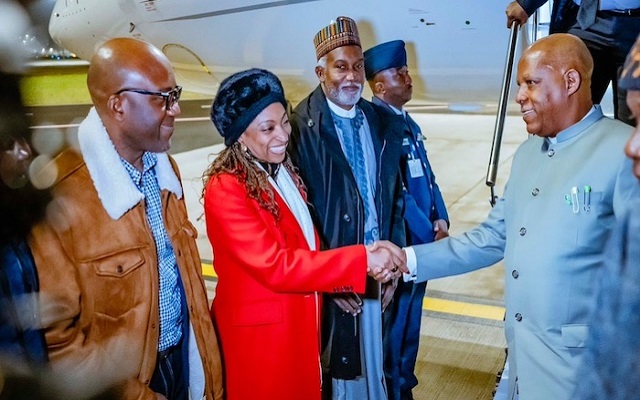
Nigeria has marked a historic milestone in its global economic diplomacy with the official unveiling of Nigeria House Davos, a sovereign pavilion on the Davos Promenade, as Vice President Kashim Shettima leads the country’s delegation to the 56th Annual Meeting of the World Economic Forum (WEF).
Scheduled to run from January 19 to 23, 2026, the WEF will convene world leaders, top policymakers, and global business executives to deliberate on pressing economic and technological challenges.
Vice President Shettima arrived in the alpine town from Conakry, Guinea, where he represented President Bola Ahmed Tinubu at the inauguration of Guinea’s President, Mamadi Doumbouya, on Saturday.
On arrival, he was received by the Minister of Foreign Affairs, Ambassador Yusuf Tuggar; the Minister of Industry, Trade and Investment, Dr Jumoke Oduwole; and officials of the Nigerian Mission in Switzerland.
The commissioning of Nigeria House Davos underscores the country’s growing ambition to project itself as a hub for investment and innovation.
According to the State House, the facility, established through a Public-Private Partnership (PPP), will serve as a permanent platform for ministerial engagements, investment roundtables, and cultural diplomacy throughout the forum.
During the meeting, Vice President Shettima is expected to present Nigeria’s 2026 economic outlook to influential political and business leaders. He will also participate in plenary sessions on the responsible deployment of artificial intelligence, quantum computing, and biotechnology.
In addition, Shettima will hold bilateral meetings with heads of state, multinational CEOs, and leaders of international development finance institutions, aimed at strengthening strategic partnerships in line with President Tinubu’s Renewed Hope Agenda.
Speaking to journalists, Dr Jumoke Oduwole emphasized that Nigeria would make a strong case for investment opportunities during the launch of Nigeria House. She explained: “We will be showcasing four playbooks on President Tinubu’s efforts in re-engineering the Nigerian economy.
“We will present our solid minerals sector, climate-sustainable agriculture, creative industries, and digital sectors to investors from all over the world.”
Nigeria’s participation at the 2026 WEF highlights the Federal Government’s determination to reposition the country as a prime destination for global capital and innovation, while amplifying its voice in international economic conversations.
