



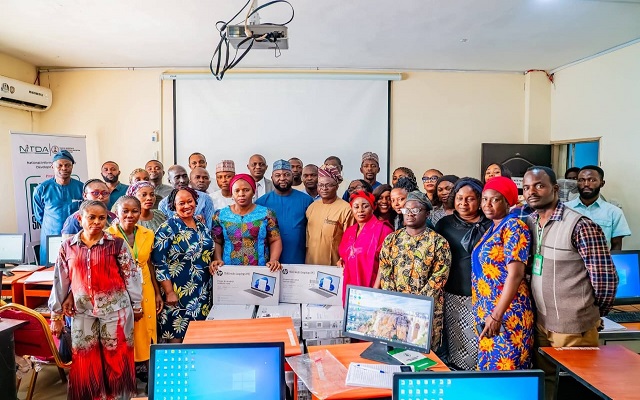
In a decisive push to entrench data-driven governance within Nigeria’s public service, the National Information Technology Development Agency (NITDA) has completed a specialised digital capacity-building programme for the Federal Character Commission (FCC), equipping the Commission with tools and competencies to strengthen its oversight mandate.
Central to the intervention was the donation of 35 laptops and hands-on training focused on data analysis and data management—core capabilities required for a Commission whose statutory responsibility is to monitor equitable representation across Ministries, Departments, and Agencies (MDAs).
The initiative aligns with President Bola Ahmed Tinubu’s priority of reforming the economy for sustained and inclusive growth, alongside improving governance for effective service delivery.
It also forms part of NITDA’s Digital Literacy for All (DL4ALL) programme, designed to build digital capacity across public sector institutions and develop a workforce capable of driving Nigeria’s broader digital transformation agenda.
The training, conducted at the Commission’s headquarters, was structured to enhance institutional performance by strengthening staff proficiency in handling large datasets—an operational necessity for effective compliance monitoring and policy evaluation.
Representing NITDA’s Director General, Kashifu Inuwa, the Acting Director of Digital Literacy and Capacity Building, Ahmed Yusuf Tambour, explained the programme’s strategic intent.
“We are here at the Federal Character Commission to carry out a training for staff of the Commission in the area of digital literacy to enhance their proficiency,” he stated.
He emphasised that the curriculum was deliberately aligned with the Commission’s mandate.
“We are particularly focusing on data analysis and data management, because this really aligns with the core mandate of the Commission,” he said.
Given that the FCC relies heavily on accurate, timely, and well-structured data to ensure fairness in public sector representation nationwide, strengthening digital capacity directly enhances its ability to manage nationwide datasets efficiently and transparently.
Describing the engagement as productive, Inuwa noted the strong reception among participants.
“So it’s been a great journey. We’ve trained 35 participants here, and the training has been very well received.”
Beyond the classroom component, the donation of 35 laptops is intended to institutionalise the gains of the programme. The devices will support continuous learning and enable seamless integration of digital tools into daily workflows—moving the Commission away from manual processes toward a more automated, analytics-driven oversight model.
Expressing optimism about the long-term impact, Inuwa added, “We are hoping that this will help the Commission to manage the very, very important data that they collect across all MDAs.”
The intervention underscores NITDA’s commitment to embedding digital competencies across government institutions under the Renewed Hope Agenda.
By pairing skill development with practical tools, the Agency is strengthening institutional efficiency, improving data integrity, and reinforcing evidence-based decision-making—key pillars in the Federal Government’s drive toward a modernised public service capable of delivering inclusive national development and economic reform.
