



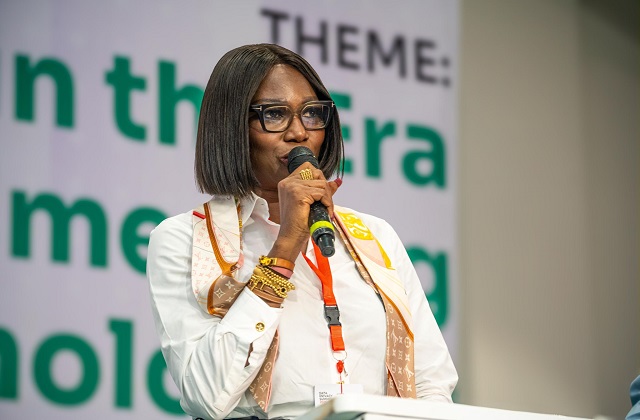
By Uchenna Agbo
In the bustling Balogun market, traders line the streets standing by their fruit stands, fashionable fabrics and sparkling jewellery. These entrepreneurs are masters of their trade, but ghosts in the digital economy. Even with phones in their pockets, they’re hesitant to take mobile money payments. They understand the technology, but they don’t always trust that their information won’t be exposed and abused.
Stories of accounts being hacked, personal information leaks, and business owners being scammed have already rippled through these communities. To them, using digital systems means giving up privacy.
In this world, digital tools are not seen as pathways to prosperity, but as potential traps for their dignity. These sellers represent the human face of Nigeria’s trust gap, and their stories explain why, despite a decade of effort, our national exclusion targets remain stubbornly out of reach.
The access first fallacy
For the better part of a decade, the conversation around digital inclusion in Nigeria has been dominated by pipes and wires. We spoke of subsea cables, 5G rollouts, and the price of entry-level smartphones. In 2026, it is becoming increasingly clear that connectivity is merely the prerequisite, not the end goal.
The burden of proof lies with us, service providers. We must demonstrate that innovation and intrusion are not two sides of the same coin.
The Central Bank of Nigeria’s National Financial Inclusion Strategy (NFIS) tells us how much is still to be done. In 2012, we set a goal to reduce financial exclusion among Nigeria’s adults to 20% by 2020, yet the exclusion rate in that year sat at 36% according to the NFIS 2022 report.
True digital inclusion is about meaningful participation. This means giving people the ability to use digital services without the fear of exposure. Beyond meeting a legal standard, addressing the privacy concerns of the underbanked is a necessary step to closing the persistent digital divide.
The Centre for Financial Inclusion (CFI) recently highlighted a sobering reality: for low-income consumers, privacy harms are not theoretical data leaks. They are lives upended. When biometric data is mishandled or personal financial habits are sold to third parties without consent, the victim doesn’t just lose a password; they lose control. Without the assurance that personal data is handled securely, ethically, and with explicit consent, the underbanked will remain exactly that: under the radar.
Trust is infrastructure
As an industry, we must move beyond seeing data privacy as a compliance tax or a technical feature to be bolted on at the end of a product cycle. Instead, we must treat trust as a core piece of infrastructure that is as essential as the spectrum we broadcast on or the towers we build.
When a user understands why their data is being used and feels certain that it will not be used against them, they will be more willing to engage.
The Nigeria Data Protection Act and the recent proactive stance of the Nigeria Data Protection Commission (NDPC) have laid the groundwork. But the law is only the floor, it’s not the ceiling. For telecommunications leaders and financial service providers, the path to the next hundred million users lies in the principles of privacy-by-design.
Privacy-by-design means embedding protection into the very architecture of our systems before a single line of code is written. It means moving away from the take-it-or-leave-it consent models that currently confuse everyday users. It means ensuring that when an AI algorithm processes data – even at the staggering scale of the 100 000 data points we analyse for a single credit decision at Optasia – it does so within a clear framework of ethical accountability.
There is also a pragmatic argument for this shift. In a market as competitive as Nigeria’s, trust is a primary driver of subscriber lifetime value.
We’ve seen in our work across 38 countries, providing micro-financing to over 120 million monthly active users, that transparency is a growth engine. When a user understands why their data is being used and feels certain that it will not be used against them, they will be more willing to engage. They move from airtime loans to micro-insurance; from basic wallets to sophisticated savings.
True digital inclusion is about meaningful participation. This means giving people the ability to use digital services without the fear of exposure.
As Nigerian telcos transition into TechCos – broadening their portfolios into areas like education and finance – the attack surface for privacy risks grows. Institutions that hold a SOC 2 Type II certification or adhere to the highest global standards of data security are building a well of trust that makes them more difficult to compete against.
Bridging the divide
Closing the gap to the CBN’s 95% adult inclusion target requires a new social contract among the private sector, regulators, and Nigerian citizens. The recent commitments within the National Digital Economy and E-Governance Act of 2024 offer a glimpse of this future: a digital society where governance is open, and citizens are active, protected participants rather than mere data points.
The burden of proof lies with us, service providers. We must demonstrate that innovation and intrusion are not two sides of the same coin. As Dr Vincent Olatunji of the NDPC recently noted, privacy is a constitutional right. But in the context of Nigeria’s development, it is also an economic necessity.
If we want to bring entrepreneurs into the digital fold, we cannot simply offer them a faster signal or a cheaper loan. We must offer them safety by proving to them that their digital footprints won’t be used to exploit them.
The next phase of Nigeria’s digital revolution must finally close the digital divide. When we build for privacy, we build for trust. And when we build for trust, we finally build for everyone.
***Uchenna Agbo is Chief Commercial Officer at Optasia
