



Nigeria’s drive to digitise its basic education system gained renewed momentum as the Universal Basic Education Commission (UBEC) sought to deepen collaboration with the National Information Technology Development Agency (NITDA), with both institutions aligning on measurable, technology-driven outcomes.
The Director General of National Information Technology Development Agency (NITDA), Kashifu Inuwa, reaffirmed the Agency’s commitment to strengthening its partnership with the Universal Basic Education Commission (UBEC) to accelerate digital literacy and expand access to technology across Nigeria’s basic education system.
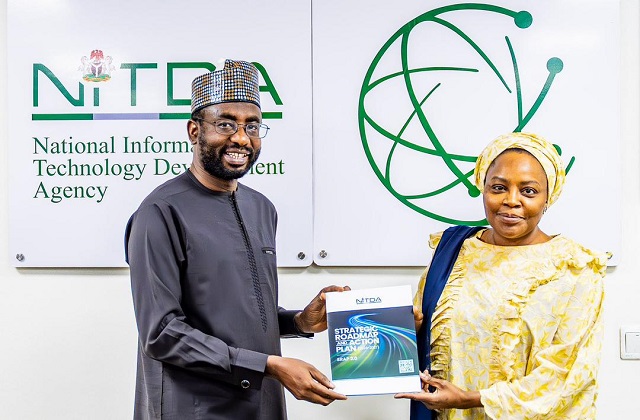
Inuwa made this known while receiving the UBEC management team, led by its Executive Secretary, Dr. Aisha Garba, during a courtesy visit to NITDA Headquarters in Abuja.
Framing the partnership as pivotal to Nigeria’s broader digital ambitions, Inuwa emphasised that collaboration between both agencies is central to achieving national digital literacy targets.
“For us, partnering with you will help us achieve more in terms of reaching all students in basic education,” he said, noting that while significant progress has been made in training teachers, the broader national objective must prioritise learners.
He explained that teacher capacity development efforts are already yielding positive results, with digital literacy modules now embedded in NITDA’s programmes and mandated for educators.
“We have achieved a lot in training teachers, but impact must be measurable,” he stated. “We need the numbers. How many students are being reached?” he asked, reiterating NITDA’s digital literacy targets of 70 per cent by 2027 and 95 per cent by 2030.
Central to this approach, he noted, is the use of data systems capable of tracking outcomes at scale. “With this system, we should be able to know each teacher and how many people they are impacting, so that we can keep proper records and have the numbers,” he said, highlighting the role of Artificial Intelligence and data analytics in monitoring progress nationwide.
On infrastructure, the Director General disclosed that NITDA has deployed over 1,500 digital learning centres across the country under its strategic pillar on promoting inclusive access to digital infrastructure and services.
While some centres are well utilised, others remain underused. “We want every Nigerian to have access to digital infrastructure and services,” Inuwa stated, proposing that both agencies share data, map their interventions, and complement each other’s efforts to maximise impact.
Addressing connectivity gaps in schools, he called for exploration of sustainable models. “Let us explore multiple services they can use. How can we get more internet services to schools,” he asked, stressing that reliable connectivity is essential to unlocking the full potential of digital learning facilities.
Beyond infrastructure expansion, Inuwa offered to share NITDA’s digital transformation playbook with UBEC to support internal reforms within the Commission. “Digital transformation is a journey. It is not a one off initiative. At each stage, when you reach your target, you need to set a new one,” he said.
He referenced NITDA’s AI transformation roadmap, which involved training all staff on Generative AI and encouraging them to develop innovative use cases.
“The idea was to train them and challenge them to see how AI can enhance what they do,” he explained, adding that, “AI is not here to replace people. If a junior staff member can transition from moving files to managing an AI system, I believe anyone can embrace and use AI.”
Inuwa further described how process re-engineering within the Agency reduced repetitive approvals and administrative bottlenecks.
“A Director General is not an expert in audit, procurement, or project management. Why can’t they just work and bring the final product for approval?” he remarked, noting that streamlined workflows enable leadership to focus more squarely on strategic direction.
In her remarks, UBEC Executive Secretary, Dr. Aisha Garba, described the partnership with NITDA as both strategic and indispensable.
“For us in UBEC, our key mandate is universal access to basic education for all Nigerian children. So, it’s a big responsibility,” she said, stressing that UBEC does not consider this mandate one it can fulfil alone. “We always seek partners that work with us—not just government agencies, but also communities and parents,” she added.
Garba underscored the magnitude of the task, noting that over 47 million children are currently within Nigeria’s basic education system. “Whatever the number is, it’s not a small one,” she said, referencing varying statistics on out of school children. “Outside basic education, you have fewer than five million. So, this is really the biggest stake we all have.”
She emphasised that collaboration with NITDA is critical to addressing both access and quality gaps. “Partnering with NITDA is a necessity for us. We need to work together to use technology to bridge the lack of access in the country and to improve the quality of education,” she said, pointing to enrolment concerns and foundational literacy challenges in some states.
Garba also expressed appreciation for the NITDA Director General’s continued support, signalling a shared commitment to building a digitally enabled basic education system capable of meeting Nigeria’s long-term development goals.
