



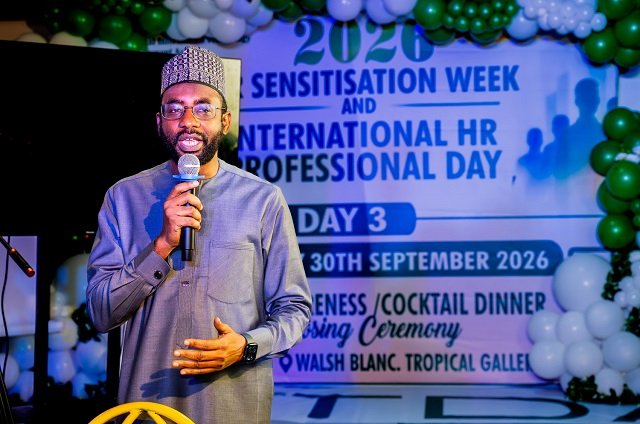
Staff of the National Information Technology Development Agency (NITDA) now have a formal channel for raising welfare, training and workplace concerns, following the inauguration of a Joint Management-Union Committee by the Director-General, Kashifu Inuwa.
Inuwa inaugurated the committee at the close of the Agency’s Human Resources Sensitisation Week 2026.
He said it was created so that staff concerns are properly heard rather than handled on an ad hoc basis. By seating management and union representatives at the same table, the committee is expected to settle employee matters through greater consultation and transparency.
The DG commended the Human Resources Department but stressed that effective management goes beyond enforcing rules and procedures, adding that employees remain central to the Agency’s ability to deliver on its mandate.
According to him, management and HR should focus more on unlocking staff potential and creating an environment in which employees can contribute meaningfully.
“People are the operating system of the Agency. We want to unlock your potential. We want to make you innovative so that the Agency will achieve its mandate. So, as we continue to manage our personnel, it’s also important to start thinking of how we can move from managing people to unlocking their potential’’.
Inuwa said the committee’s work would not be limited to training but would serve as a broader mechanism for dealing with issues affecting staff welfare. He declared it inaugurated and urged its members to begin work with utmost urgency.
The move followed staff complaints about how training opportunities and other benefits were allocated. The DG agreed that training and capacity development should take performance and contribution into account rather than rely solely on rank.
Staff also used the forum to point to gaps in working tools and to call for faster intervention when employees face medical emergencies or accidents.
In response, the DG said the Agency had procured digital tools and was working to ensure that every staff member has the equipment needed to perform effectively. He added that the Agency had expanded training opportunities in recent years, including international programmes.
Inuwa explained that the feedback session let the HR Department see both what it was doing well and where it needed to improve. He described the relationship between management and employees as a “social contract” in which both sides have responsibilities.
While calling for continued attention to staff welfare, the DG challenged staff to reciprocate with stronger commitment, productivity and punctuality. Improved welfare, he advised, must be matched by performance, since the Agency benefits more when staff are given the right conditions to develop their capabilities and contribute fully to its mandate.
The joint committee comprises management representatives, including the Director of Finance, the Director of Human Resources, the DG’s representative and auditors. The union will nominate four representatives.
Earlier, the Agency’s Director of Human Resource Management, Mr Sarafa Lawal, observed that HR had evolved beyond recruitment, personnel administration and staff welfare into a strategic function in innovative organisational performance.
He noted that modern HR practice must help shape organisational capability, culture, performance and sustainability by ensuring that employees understand the Agency’s direction, their responsibilities and the opportunities available for their growth.
Lawal described employees as a strategic asset rather than merely a cost to be managed, arguing that investment in training, professional development, coaching and career development should be seen as investment in institutional capacity.
He said human capital development is a shared responsibility involving HR, directors, heads of departments and individual employees. HR must provide the policies, systems, tools and support; managers must provide leadership, coaching and feedback; and employees must take ownership of their responsibilities and performance.
The three-day programme combined professional development with activities meant to encourage interaction and recognise staff contributions. It featured a football competition, a workshop for administrative staff introducing the new HR T-Model, and an HR Clinic session where employees could engage on human resource-related matters.
The closing ceremony, attended by top management, heads of departments and unit heads, also included awards for excellent performance, attendance and punctuality, as well as gifts for the best-dressed staff. Cleaners, security personnel and other support staff were among those recognised.