



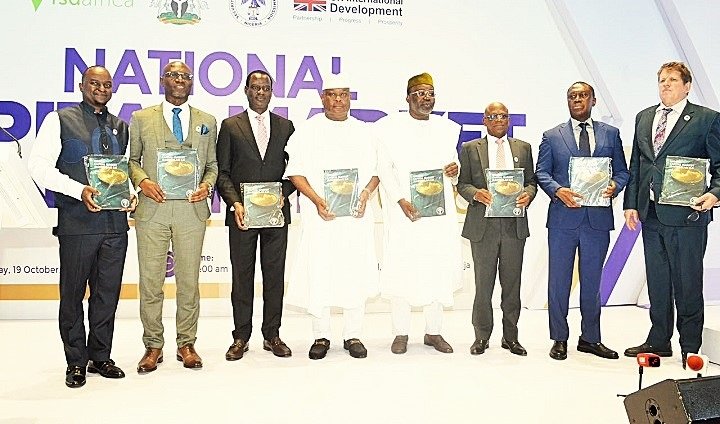
Nigeria has launched a ten-year roadmap to deepen its capital markets, mobilise domestic and international investment, and support its ambition to build a US$1 trillion economy by 2030. Also launched was a national savings plan.
The Nigeria Capital Market Masterplan 2.0, covering 2026 to 2036, sets out reforms to create a more diverse, efficient and transparent market and strengthen Nigeria’s position as a regional financial hub.
The plans were launched by Vice President Kashim Shettima, alongside Taiwo Oyedele, Minister of Finance and Coordinating Minister of the Economy, Peter Vowles, the United Kingdom (UK) High Commissioner to Nigeria, and Mark Napier, CEO, FSD Africa.
The Masterplan was developed by Nigeria’s Securities and Exchange Commission (SEC) with technical support from FSD Africa funded by the UK government. Their support enabled the engagement of a consortium led by Genesis Analytics and Bourse Consult to support the development of the roadmap and its implementation framework.
Speaking at the event, Dr. Emomotimi Agama, SEC Nigeria Director General, hailed the master plan as one that will help Nigeria deepen Nigerian capital markets to the scale needed to finance the country’s ambitious economic goals.
“Every great economy has, at its heart, a capital market that turns the savings of ordinary people into the factories, roads, homes and businesses that create jobs. Nigeria has the people, the enterprise and the ambition. What we are now building is a market to match them,” said the DG.
Emphasising the historic alignment of economic reforms and regulatory empowerment, Dr. Agama noted that the Master Plan was deliberately launched alongside the National Savings Scheme to harness homegrown resources for national development.
“Savings are the raw material of investment, and a nation that saves through its own capital market builds with its own resources,” Dr. Agama added.
The British High Commissioner to Nigeria, Pete Vowles, represented by Paul Healey, Head of Green Growth and Private Sector Development at the British High Commission, said:
“The UK is proud to have funded FSD Africa’s support for the development of Nigeria’s Capital Markets Masterplan 2.0. This ambitious, Nigerian-led reform will help mobilise more domestic and international investment and connect capital with commercial opportunities in businesses and infrastructure.
“Our support forms part of the wider UK and Nigeria’s strategic partnership, which has growth and jobs at its heart. By strengthening Nigeria’s capital markets and deepening links between our financial sectors, we can create new opportunities for investment, jobs and shared prosperity in both our countries.”
Mark Napier, CEO, FSD Africa, lauded the master plan as key in guiding Nigeria’s ambitions to deepen her capital markets for greater growth and job creation.
“Our support for Nigeria’s new Masterplan is grounded in the principle that capital markets need to work for the wider economy. With its scale and regional importance, Nigeria has a significant opportunity to mobilise more domestic and international capital towards businesses, infrastructure and sustainable growth,” he said.
“We have seen how sustained capital market development can help create conditions for greater capital mobilisation. In Zambia and Ethiopia, our support to strengthen the country’s financial market architecture and address key regulatory and market constraints helped lay the foundations for greater capital mobilisation, including into sectors such as renewable energy,” he added.
FSD Africa’s support has focused on strengthening the link between capital-market development and Nigeria’s wider economic priorities, including infrastructure, SME growth, financial inclusion and sustainable development.
NCMMP 2.0 seeks to position capital markets as a driver of wider economic transformation, helping to channel long-term capital towards national priorities including infrastructure, energy, climate resilience, SMEs, financial inclusion and job creation.
To support these ambitions, proposed reforms include measures making it easier for businesses and state governments to raise capital, expand retail and diaspora participation, attract more foreign institutional investors, strengthen sustainable finance, and support the development of digital and tokenised assets.
The Masterplan is structured around five pillars covering regulatory clarity and enforcement, modernising market infrastructure, broadening the range of issuers and financial instruments, diversifying the investor base, and strengthening institutional and professional capacity. A sequenced implementation plan with clear ownership, timelines and measures of success supports each pillar.
It also builds on lessons from the previous Capital Market Masterplan, which supported a number of significant reforms while leaving areas for further progress. The earlier plan achieved an overall activity completion rate of 63%, with financial inclusion, regional integration, sustainable finance and the mobilisation of capital to priority sectors among the areas identified for continued progress.
The Masterplan also sets out ambitions to strengthen Nigeria’s regional role through greater cooperation with other African markets, cross-border capital raising and listing frameworks, and closer alignment with initiatives under the African Continental Free Trade Area.
