




The Federal Government’s drive to build a digitally skilled population has recorded 2,769,512 digital literacy training achievements in three years, representing just 5.54 per cent of the 50 million beneficiaries targeted by 2027.
The figures, captured by the National Digital Literacy Dashboard unveiled at the 2026 National Digital Literacy Workshop in Abuja, underscore the scale of the challenge facing Nigeria as it seeks to equip citizens with the competencies required to thrive in an increasingly technology-driven economy.
The dashboard shows that 252 organisations, including the National Information Technology Development Agency (NITDA), are reporting digital literacy interventions across all 36 states, the Federal Capital Territory and the country’s 774 local government areas.
The initiative is being coordinated by NITDA under its Digital Literacy for All (DL4ALL) programme, which seeks to expand access to digital skills through partnerships with government institutions, technology companies, educational institutions, non-governmental organisations and other stakeholders.
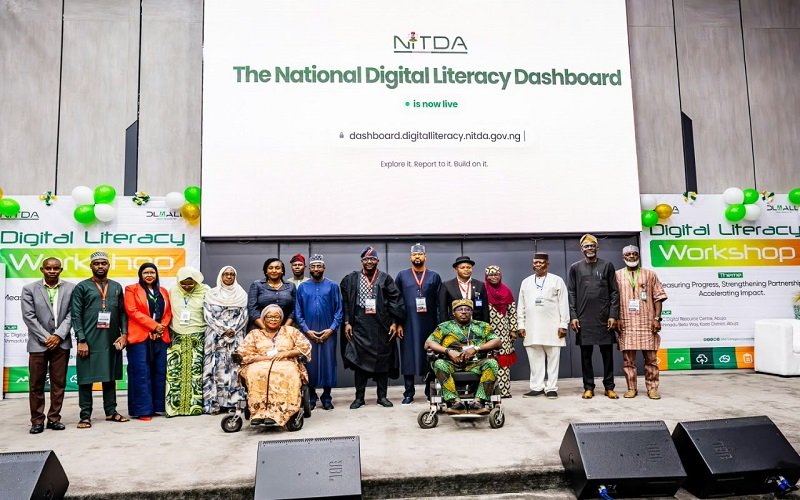
Speaking at the workshop, NITDA Director-General, Kashifu Inuwa stressed that Nigeria’s ability to harness its human capital would depend largely on deliberate investments in digital capabilities to boost productivity and expand economic opportunities.
He described digital literacy as a basic necessity in modern society, comparable to reading, writing and numeracy, particularly as technology and artificial intelligence continue to reshape how people learn, work, communicate, trade and access public services.
“Our ambition is not to turn every Nigerian into an IT professional. Our ambition is to make every Nigerian digitally capable,” Inuwa said.
He explained that the goal was to enable citizens to deploy digital tools to improve their existing occupations and livelihoods, rather than necessarily become technology professionals.
According to him, traders could use digital platforms to maintain business records and receive electronic payments, farmers could access weather forecasts and market information, teachers could enhance classroom learning, and public servants could improve the efficiency of service delivery.

The dashboard’s demographic data indicate that young people below the age of 35 account for 2,092,697 reported training achievements, while informal-sector workers represent 1,609,183.
Female participation stands at 32.9 per cent, while 65,767 beneficiaries are recorded from rural communities and 17,156 are persons with disabilities.
The figures point to the need for more targeted interventions to ensure that women, rural residents and persons with disabilities are not left behind in the country’s digital transformation drive.
A breakdown of participating organisations shows that companies constitute the largest group, with 151 out of the 252 reporting organisations, representing 59.9 per cent. Government institutions account for 43 organisations, while non-governmental organisations contribute 34. Cooperatives, community organisations and other entities make up the remaining participants.
Among the leading contributors, Cisco recorded 1,073,604 training achievements, followed by NITDA with 960,424 and Meta Platforms Inc. with 333,816.
Other contributors include Imo Digital City Limited, the Sokoto State Ministry of Innovation and Digital Economy, the Bureau for ICT and Digital Economy, technology agencies in Jigawa, Kaduna and Zamfara states, and the Centre for Information Technology and Development.
Inuwa said the launch of the dashboard would improve coordination among stakeholders, help identify underserved communities and ensure that investments in digital literacy delivered measurable results.
He observed that the absence of a coordinated reporting mechanism had sometimes led to multiple organisations implementing similar interventions in the same communities, while other areas remained underserved.
“At NITDA, we see our role as an ecosystem orchestrator,” he said, explaining that the agency’s responsibility extended beyond implementing its own programmes to developing standards, partnerships and coordination mechanisms that would enable stakeholders to maximise their collective impact.
The NITDA chief, however, cautioned against interpreting the reported training achievements as the number of unique Nigerians who had attained a defined level of digital proficiency.
He stressed that the figures must be complemented by credible assessments to establish the competencies acquired by participants, how they apply their skills and the tangible benefits to their lives and communities.
According to him, the agency intends to assess progress beyond training attendance by determining whether beneficiaries can communicate more effectively, protect themselves against online fraud, access information with confidence, and improve their businesses, jobs, and livelihoods.
The National Digital Literacy Framework, established in 2023, provides the foundation for the initiative. It identifies six core competence areas: device and software operations; information and data literacy; communication and collaboration; digital content creation; digital safety; and problem-solving.
NITDA launched the DL4ALL programme in 2024 to translate the framework into practical interventions across formal education, workforce development and the informal sector.
Its collaboration with the National Youth Service Corps has also facilitated the deployment of Digital Literacy Champions to markets and communities. Programme records indicate that the informal-sector initiative has engaged more than 20,000 trainers and over 803,000 trainees.
The National Digital Literacy Framework targets 70 per cent digital literacy by 2027 and 95 per cent by 2030, in line with the Federal Government’s broader ambition to build a $1 trillion economy by the end of the decade.
Earlier, speakers at the workshop called on state governments, technology companies, educational institutions, development partners and civil society organisations to register their interventions and submit credible data to the dashboard.
They emphasised that achieving the national digital literacy targets required collective responsibility, stronger coordination and sustained participation from public- and private-sector stakeholders.
The overarching objective, they noted, is to make digital literacy accessible to all Nigerians, enabling citizens to improve their productivity, access economic opportunities and contribute meaningfully to national development.