



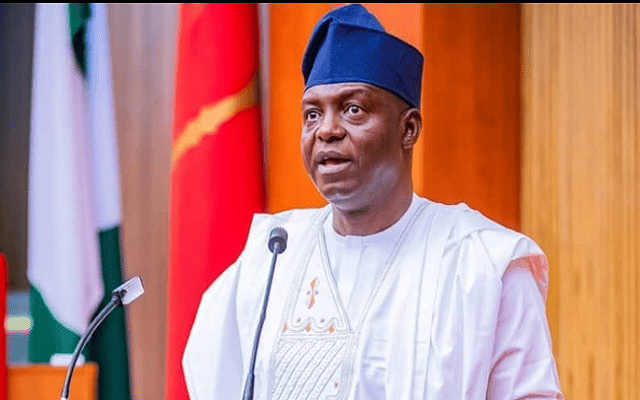
The Federal Government has secured $800 million in sovereign financing for its ambitious national broadband expansion project but requires an additional $1.2 billion in private investment to complete the initiative, which aims to extend fibre-optic infrastructure across Nigeria by 2028.
The project, known as Project BRIDGE, is designed to deploy 90,000 kilometres of open-access fibre-optic cables across the 36 states, increasing Nigeria’s combined fibre backbone from approximately 35,000 kilometres to 125,000 kilometres and connecting more than 200,000 schools, health facilities and other public institutions.
National Chairman of the All Progressives Congress (APC), Professor Nentawe Yilwatda, disclosed this during a virtual executive session with chief executives of the information technology industry on Wednesday.
In a statement issued by his Special Adviser on Media and Information, Abimbola Tookj, Yilwatda described digital infrastructure as essential to Nigeria’s economic transformation, stressing that ambitions in artificial intelligence (AI), cloud computing and digital inclusion depended on reliable, affordable connectivity.
He said the Federal Government incorporated Bridge Open Access as an independent company in August to deliver the project. Under the proposed ownership structure, the government, through the Ministry of Finance Incorporated, will hold between 25 and 49 per cent equity, while private investors will own between 51 and 75 per cent and retain operational control.
According to him, the arrangement is intended to combine government support with private-sector investment, efficiency and operational discipline.
Yilwatda said the financing secured so far comprised $500 million from the World Bank, $100 million from the European Bank for Reconstruction and Development and $200 million from the African Development Bank, alongside a €22 million grant from the European Union.
Physical deployment is scheduled to begin in October 2026, with the completion timeline reduced from five years to three years.
“When completed, the project is expected to take Nigeria’s combined backbone from about 35,000 kilometres to around 125,000 kilometres and connect more than 200,000 schools, health facilities and other public institutions,” he said.
However, the APC chairman warned that the initiative’s success would depend on implementation rather than policy announcements.
“Announcements do not lay cable,” he said, noting that private capital of about $1.2 billion was still needed to meet the project’s financing requirements.
He also cautioned that fibre deployment alone would not guarantee digital inclusion without complementary investments in electricity, affordable devices and data services, telecommunications towers, backhaul infrastructure and last-mile connectivity.
Highlighting the challenges facing operators, Yilwatda said fibre infrastructure remained concentrated in major urban centres, with Lagos and the Federal Capital Territory accounting for more than 18 per cent of deployed fibre. He added that fibre-to-the-home penetration remained low, with approximately 265,000 subscribers nationwide.
He identified high right-of-way charges, inconsistent regulatory requirements, multiple permits and the destruction of installed telecommunications infrastructure by some state and local government authorities as significant barriers to expansion.
To address these challenges, he said the APC National Secretariat would work with the Progressive Governors’ Forum and party chapters in APC-controlled states to promote harmonised, cost-reflective right-of-way charges and protect telecommunications infrastructure.
He also urged governors from other political parties to support the initiative, describing digital connectivity as a national development priority.
“Infrastructure has no party. Our objective should be to create an environment in which every Nigerian, regardless of political affiliation or location, can benefit from the digital economy,” he said.
Yilwatda further called for fibre-optic infrastructure to be designated Critical National Information Infrastructure, warning that vandalism and accidental damage could undermine substantial public and private investments.
He advocated closer coordination between road construction and telecommunications development, noting that excavation and civil works accounted for many fibre cuts.
While commending the Federal Ministries of Works and Communications, Innovation and Digital Economy for establishing a Standing Committee on the Protection of Fibre Optic Cables, he urged the extension of the initiative to state and local governments.
He proposed that federal and state road contracts should include provisions for telecommunications ducts and require contractors to identify and protect existing fibre cables before excavation.
“Building a road and destroying a broadband link in the same month is not development. It is waste.”
On emerging technologies, Yilwatda said Nigeria must position itself to shape and benefit from the AI revolution rather than depend solely on technologies developed elsewhere.
“The question for Nigeria is not whether AI will shape our economy. It will. The question is whether we will shape it or rent it,” he said.
He noted that the country had a National Artificial Intelligence Strategy. At the same time, the National Digital Cloud Policy seeks to attract approximately $750 million in private investment into cloud and data infrastructure within 24 months, including $250 million in the first year.
He added that the government and industry were working to increase data-centre capacity from approximately 50 megawatts to 200 megawatts of IT load over five years.
However, he stressed that these ambitions required parallel investment in reliable energy, given the substantial power demands of data centres and AI infrastructure.
“An AI strategy without an energy strategy is incomplete,” he said, advocating embedded generation, renewable power purchase arrangements and reliable gas supply for digital infrastructure clusters.
On data sovereignty, Yilwatda supported policies favouring certified local technology providers in public procurement where appropriate, saying domestic capacity development and data protection were legitimate national priorities.
He, however, cautioned against turning digital sovereignty into protectionism that could raise costs, discourage investment or restrict access to global expertise and technology.