



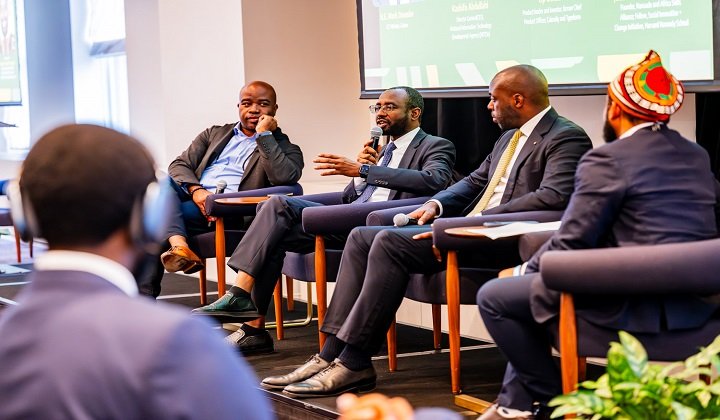
The Director-General/CEO of the National Information Technology Development Agency (NITDA), Kashifu Inuwa Abdullahi, has called on African policymakers to shift their focus from counting trained youth to ensuring digital skills actually translate into jobs, enterprise, and improved livelihoods.
Abdullahi made the call while speaking on the high-level panel “Scaling Africa’s Digital Workforce,” part of the Digital Skills and Talent Session under “Nigeria at Scale: Building Digital Systems for Shared Prosperity,” held on the sidelines of the 81st United Nations General Assembly (UNGA81).
He was joined on the panel by Gabon’s ICT Minister, H.E. Mark Doumba, and product leader and investor Oji Udezue, former Chief Product Officer at Calendly and Typeform. The session was moderated by Joannes Paulus Yimbesalu, founder of Nanaade and the Africa Skills Alliance, and a Fellow at Harvard Kennedy School’s Social Innovation + Change Initiative.
Speaking candidly about the continent’s training-to-employment gap, Abdullahi said: “We have industrialised training; we have not yet industrialised the transition.”
He outlined three barriers standing between young Africans and meaningful work: a “trust gate,” where employers lack reliable ways to verify candidates’ capabilities; a “platform and connectivity gate,” created by limited access to devices, affordable internet, stable power and opportunity; and a “demand gate,” where the number of job seekers far outstrips available formal employment.
Nigeria’s Approach
Turning to Nigeria’s own strategy, Abdullahi explained that NITDA and the Federal Ministry of Communications, Innovation and Digital Economy are deliberately weaving together digital literacy, advanced technical training, connectivity, cloud infrastructure and job creation into a single transformation agenda.
He pointed to the 3 Million Technical Talent (3MTT) programme, which has now trained over 143,000 fellows across three cohorts, and the accompanying Talent Registry, built to match verified skills with employers actively hiring.
He also spotlighted Project BRIDGE, an ambitious infrastructure push to lay at least 90,000 kilometres of open-access fibre, extending Nigeria’s national backbone to roughly 125,000 kilometres and reaching all 774 Local Government Areas. The project aims to bring connectivity to thousands of schools, hospitals and local government offices—ensuring talent outside major cities isn’t locked out of the digital economy.
Literacy Versus Employability
A key thread in Abdullahi’s remarks was the distinction between digital literacy and digital employability. Under NITDA’s Strategic Roadmap and Action Plan (SRAP 2.0), basic digital literacy aims to equip every Nigerian with the foundational skills to participate safely in the digital economy, while advanced initiatives like 3MTT target specialised fields such as AI and machine learning, data science, software development, cloud computing and cybersecurity.
Beyond Formal Jobs
Abdullahi cautioned that Africa’s digital workforce strategy cannot be built around formal employment alone. Digital inclusion, he argued, must also reach traders, artisans, farmers, mechanics, transport operators, food vendors and other entrepreneurs whose businesses stand to be transformed by technology.
For this segment of the population, he said digital skills should mean practical, everyday capabilities: using smartphones productively, accepting digital payments, marketing on social media, finding customers and suppliers, keeping digital records, guarding against fraud, accessing digital services, and using AI tools to boost productivity.
“The question is not, ‘Can this person get a technology job?’ It is, ‘Can technology help this person earn more, reduce costs, reach more customers and run a better business?'”
A Call to Action
Abdullahi closed with a pointed appeal to redirect investment toward the gap between training and employment:
“Fund the corridor, not another classroom, verifiable credentials and first-paid-work placement, because Africa’s young people are stuck in the gap between the certificate and the paycheck.”
For NITDA, he stressed, success will ultimately be measured not by how many Nigerians pass through training programmes, but by how many go on to convert those skills into jobs, enterprise, higher productivity, greater income and full participation in the digital economy.