



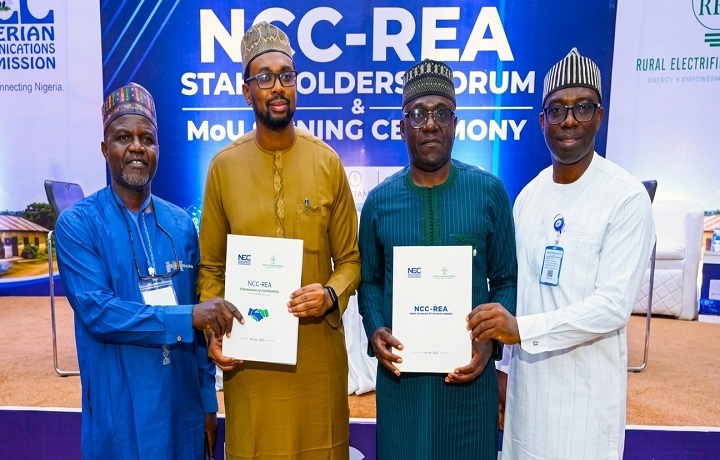
The Nigerian Communications Commission (NCC) and the Rural Electrification Agency (REA) have sealed a landmark partnership to accelerate the deployment of sustainable digital infrastructure across Nigeria by integrating renewable energy solutions with telecommunications networks.
The agreement was formalised through a Memorandum of Understanding (MoU) signed during the NCC–REA Stakeholder Workshop held at the NCC Annex Office Auditorium, Mbora, Abuja, on Friday, July 24, 2026.
The workshop, themed “Unlocking the Energy–Telecoms Nexus for Scalable Digital Infrastructure in Nigeria,” brought together senior government officials, telecom operators, tower companies, renewable energy developers, financiers, and development partners to deliberate on practical strategies for expanding connectivity through sustainable energy.
Speaking at the event, NCC’s Executive Vice Chairman/CEO, Dr. Aminu Maida, represented by Executive Commissioner, Technical Services, Engr. Abraham Oshadami, described the collaboration as a milestone in Nigeria’s pursuit of inclusive digital connectivity and energy access.
“Reliable electricity and digital connectivity are not two separate development goals. They are mutually reinforcing foundations of the same objective that produces an inclusive and productive economy,” he said.
Oshadami stressed that communities without stable electricity struggle to sustain telecom infrastructure, while those lacking connectivity cannot fully benefit from electrification.
He explained that the MoU establishes a framework for aligning telecommunications and rural electrification programmes through coordinated planning, shared infrastructure, and renewable energy solutions.
Under the arrangement, the REA will provide geospatial data on existing and planned electrification projects, while the NCC will share information on Universal Service Provision Fund (USPF) deployments. This will enable both agencies to jointly identify energy and connectivity gaps for more effective planning.
Oshadami added that the collaboration would explore powering telecom infrastructure such as base stations and fibre repeater sites through REA’s off-grid renewable energy projects, while encouraging co-location of telecom assets on REA-developed energy facilities.
According to him, the initiative will reduce deployment costs, improve efficiency, and accelerate connectivity in underserved communities.
In his remarks, REA’s Managing Director/CEO, represented by the Executive Director, Technical Services, Engr. Umar Abdullahi Umar, emphasised that Nigeria’s digital economy depends on reliable energy infrastructure.
He noted that renewable energy mini grids provide a cleaner, more sustainable alternative to diesel-powered telecom sites and that the partnership would create commercially viable opportunities for telecom operators and renewable energy developers alike.
“Reliable power and universal connectivity are not competing priorities. They are the same priority, approached from two directions. Where we deliver them together, the cost of each falls, and the reach of both extends,” he said.
The workshop featured presentations by the NCC–REA Collaboration Committee on geospatial analysis, pilot project opportunities, and implementation strategies, alongside panel discussions on financing models, regulatory frameworks, and infrastructure planning.
Oshadami urged stakeholders to move beyond broad expressions of support by identifying practical financing mechanisms, commercial models, and regulatory measures capable of translating the initiative into sustainable, large-scale projects.
The MoU represents a significant step in strengthening collaboration between the NCC and REA towards achieving the Federal Government’s digital economy and rural development objectives.
Through the partnership, both agencies aim to improve infrastructure planning, expand broadband connectivity, promote renewable energy adoption in telecommunications networks, and deliver resilient, scalable, and sustainable digital infrastructure that will drive socio-economic development across Nigeria.
This development underscores Nigeria’s commitment to bridging the gap between energy access and digital connectivity, ensuring that underserved communities benefit from both simultaneously. It also highlights the growing role of renewable energy in powering the nation’s digital future.