



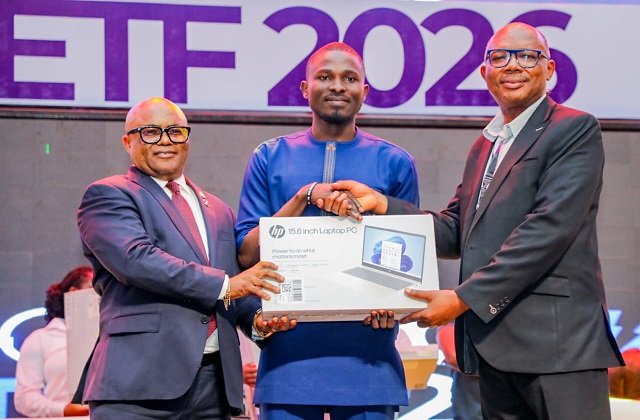
Enugu’s push to reposition itself as a digital powerhouse received a major boost as the National Information Technology Development Agency (NITDA) empowered 50 young innovators with digital tools, drawing commendation for Governor Peter Mbah over his strategic support for the Agency’s South-East Zonal Office.
The empowerment, which followed an intensive digital skills programme that attracted over 900 registered youths on NITDA’s training platform, saw 50 outstanding participants equipped with tools to scale their innovation, while an additional 250 participants were recognised for excellence and dedication.
Delivering his goodwill message, NITDA DG Kashifu Inuwa, represented by Dr. Aristotle Onumo, Director of Stakeholders Management and Partnerships at the agency, credited Governor Mbah’s backing as instrumental to the successful launch and rapid growth of the South-East Zonal Office, now ranked among NITDA’s top-performing offices nationwide.
Inuwa noted that Enugu, historically known as Nigeria’s coal city, is undergoing a profound economic shift. “Enugu was once an energy capital powering industries from beneath the earth. Today, the energy driving Enugu is the creativity, talent, and determination of its young people,” the DG’s message read.
Framing digital capacity as a strategic economic imperative, Inuwa cited projections that the global digital economy could contribute as much as $23 trillion to global GDP in the coming years, and stressed that investments in digital skills today would determine national prosperity tomorrow.
“Nigeria must not only consume technology but create it. Innovation must become our currency, and digital skills must become the bridge to opportunity,” he emphasised, reiterating NITDA’s target of achieving 70 per cent digital literacy among Nigerians by 2027.
The initiative, he explained, aligns with the Agency’s broader strategy to transition Nigeria from a resource-dependent economy to a knowledge-based system powered by innovation, entrepreneurship, and technology.
Governor Mbah, in his remarks, described the festival not merely as a technology conference but as “a reinforcement of intent” and validation of Enugu’s ambition to become a credible node in Nigeria’s expanding innovation ecosystem.
Drawing parallels between the state’s historic coal industry and its emerging digital future, he observed that while coal once powered industries across Europe and West Africa, much of the economic value left the state. Today, he argued, Enugu’s most valuable resource is its people—their creativity, skills, and innovative potential.
By prioritising investment in technology, education, and digital infrastructure, the Governor said the state is positioning itself to convert local ideas into globally competitive solutions, establishing Enugu as a hub of knowledge and digital innovation.
Referencing global technology giants such as Apple Inc., Microsoft, Amazon, Meta Platforms, and Tesla Inc., he underscored that control of digital infrastructure defines economic leverage in the 21st century.
“Find what is broken, understand it deeply, and fix it properly,” Mbah advised, stressing that innovation is less about glamour and more about solving real-world problems.
He highlighted the state’s integration of artificial intelligence into security operations, digitisation of core government processes, and deployment of Geographic Information Systems in land administration to enhance operational efficiency and strengthen land rights.
Earlier, the Commissioner for Innovation, Science and Technology, Dr. Prince Lawrence Ezeh, welcomed participants and reflected on progress since the festival’s inaugural edition.
He disclosed that thousands of youths have benefited from digital skills programmes, strategic partnerships have been forged, including Nigeria’s largest tech hub initiative, and technology clusters in blockchain and gaming have expanded, reinforcing Enugu’s profile as an emerging national tech leader.
Dr. Ezeh further outlined the core objectives of ETF 2026: transforming businesses through innovative strategies aligned with the digital economy and strengthening communities through collaboration and resilience.
He also revealed ongoing reforms aimed at embedding technology across governance and public services, including advanced real-time security systems, smart green schools, and modernised public service platforms.
The event attracted prominent dignitaries, including Anna Vesterholm, Ambassador of Sweden to Nigeria; Aminu Maida, Executive Vice Chairman of the Nigerian Communications Commission; as well as captains of industry and leading technology experts.
