



Nigeria’s ambition of building a $1 trillion economy by 2030 will depend largely on its ability to translate digital innovation into industrial productivity, business growth, investment and job creation, stakeholders have said.
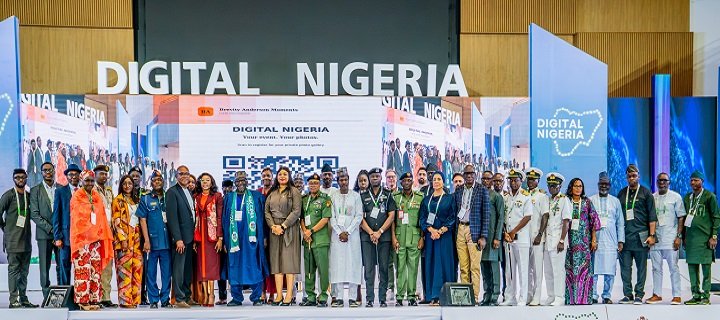
The position formed a major highlight of the 2026 Digital Nigeria International Conference and Exhibition (DNICE), held at the President Bola Ahmed Tinubu International Conference Centre, Abuja, where government officials, industry leaders, security agencies and technology innovators called for stronger collaboration to accelerate the country’s digital transformation.
Delivering the keynote address, the Director-General of the Nigerian Association of Chambers of Commerce, Industry, Mines and Agriculture (NACCIMA), Engr. Olusola Obadimu, challenged stakeholders to move beyond conversations about technology and concentrate on converting innovation into measurable economic outcomes.
According to him, the challenge is no longer whether digital technology will transform Nigeria’s economy but how effectively the country can connect it to productivity, industrialisation, exports and national prosperity.
“We are no longer debating whether digital technology will transform our economy. It already is. The question is whether Nigeria will merely consume that transformation or deliberately connect it to productivity, industrialisation, jobs, exports and national growth,” he said.
Obadimu noted that achieving President Bola Ahmed Tinubu’s $1 trillion economic vision would require stronger alignment between technology, enterprise and investment, stressing that sustainable growth must be driven by productive businesses across agriculture, manufacturing, mining, trade and services.
“The road to a one-trillion-dollar economy runs through productivity. That economy will not be built in government offices. It will be built on farms, in factories, in laboratories and through businesses that create value every day,” he stated.
He identified Micro, Small and Medium Enterprises (MSMEs) as critical to economic transformation, insisting that digital policies must translate into improved productivity and competitiveness for small businesses.
He also highlighted the partnership between NACCIMA and the National Information Technology Development Agency (NITDA) as a strategic platform for bridging the gap between innovation and commercialisation.
On its part, NITDA called for stronger collaboration among government institutions, industry, academia, innovators and development partners to build a secure, intelligent and inclusive digital economy.
The agency’s Director-General, Kashifu Inuwa, represented by the Director of Special Duties, Dr Aristotle Onumo, described the digital economy as a strategic driver of national development, innovation and competitiveness.
“We are not here merely to discuss the future; we are here to build it. Digital Nigeria is designed to move beyond conversations to implementation, collaboration and measurable impact,” he said.
Onumo said Nigeria possessed the talent and entrepreneurial capacity to become a leading digital economy but needed deliberate investments in infrastructure, skills development, entrepreneurship and strategic partnerships.
He explained that the conference focused on identifying the people who would build Nigeria’s digital future, determining how it would be achieved, equipping citizens with relevant skills and recognising organisations and individuals driving excellence in the ecosystem.
A major practical demonstration of this vision was the Builders Festival, which sought to connect Nigerian innovators with real-world challenges, funding and industry opportunities.
Presenting insights into the initiative, Glory Olamigoke and David Ogobe explained that organisers invited companies and institutions to submit operational challenges requiring innovative solutions. Following an assessment, 21 priority challenges were selected and opened to startups, developers and innovators nationwide.
The initiative attracted more than 1,500 applications, from which 30 finalists emerged to develop prototypes before investors, industry leaders and judges.
The overall winner received a $50,000 equity-free grant, while other outstanding innovators secured grants ranging from $10,000 to $30,000, alongside mentorship and business development opportunities.
Olamigoke and Ogobe said the initiative addressed a major challenge facing Nigeria’s innovation ecosystem: connecting talented innovators with funding, mentorship, infrastructure and market opportunities needed to build sustainable businesses.
Meanwhile, stakeholders stressed that digital transformation must be supported by cybersecurity, responsible data governance and inclusion.
Delivering a goodwill message on behalf of the Chief of Army Staff, General Waheed Shuaibu, the Commander of the Nigerian Army Cyber Warfare Command, Major General E. S. Mustapha, warned that artificial intelligence and emerging technologies had introduced new cybersecurity vulnerabilities and national security challenges.
He described cybersecurity and digital resilience as strategic national priorities, calling for stronger collaboration, capacity building and investment in digital skills.
Similarly, the Inspector-General of Police, Tunji Disu, represented by Commissioner of Police Ayodele Oluyemi, highlighted the growing importance of artificial intelligence, data analytics, digital forensics and secure communication systems in intelligence-led policing.
The National Commissioner and Chief Executive Officer of the Nigeria Data Protection Commission (NDPC), Dr Vincent Olatunji, represented by the Head of the Innovation Department, Ms Adaobi Nwankwo, reaffirmed the commission’s commitment to data privacy, responsible governance and digital trust.
He noted that public confidence was fundamental to digital transformation, particularly as citizens and businesses increasingly relied on digital platforms.
Also speaking, Mr Paul Apiade, representing the Federal Character Commission, stressed that technology must expand opportunities rather than create new forms of exclusion. He urged stakeholders to ensure that all Nigerians, irrespective of geography, gender or social background, benefited from the digital economy.
He also identified cybersecurity, data protection and digital trust as essential foundations for inclusive digital development.
The conference concluded with a shared recognition that Nigeria’s digital potential could only translate into economic prosperity through stronger connections between innovation and industry, startups and markets, skills and jobs, and investment and enterprise.
Ultimately, the success of Digital Nigeria 2026 will be measured not by speeches and exhibitions but by businesses created, innovations commercialised, investments attracted, jobs generated and lives transformed.