



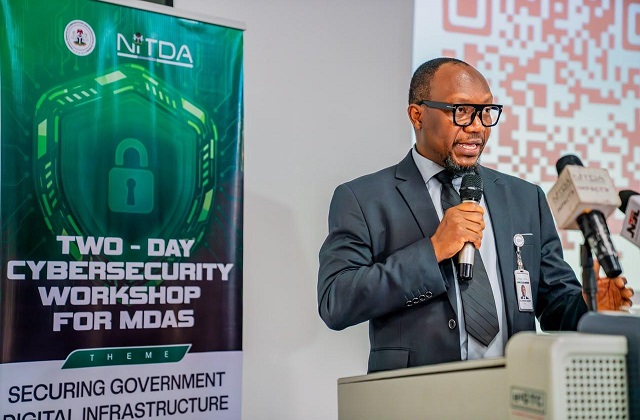
The National Information Technology Development Agency (NITDA) has intensified its drive to strengthen Nigeria’s cyber resilience, calling on Ministries, Departments and Agencies (MDAs) to embrace a unified, proactive and collaborative approach to protecting government digital infrastructure from increasingly sophisticated cyber threats.
The charge was delivered at the opening of a two-day Cybersecurity Workshop for MDAs, themed “Securing Government Digital Infrastructure through Capacity Building,” where the Director General of NITDA, Kashifu Inuwa, was represented by the Assistant Director in the Agency’s Cybersecurity Department, Dr. Ayodele Bakare.
Addressing participants, Inuwa said the workshop was convened at a critical time when cyberattacks targeting government digital platforms have become more frequent, sophisticated and disruptive.
He noted that incidents ranging from website defacement and ransomware attacks to data breaches and the misuse of personal information now constitute significant threats to governance, public confidence and national development.
He observed that government digital platforms, relied upon daily by millions of Nigerians for essential services, have become increasingly attractive targets for cybercriminals.
“We have watched websites of government organisations defaced, hijacked and quietly redirected to gambling sites. We have seen coordinated ransomware attacks force government web portals to shut down and witnessed repeated attacks on government databases leading to data exfiltration and abuse of personal data,” he said.
Highlighting the scale of the challenge, the NITDA Director General cited findings from the United Nations Office on Drugs and Crime (UNODC) Cybercrime Assessment for Nigeria, which identified Nigeria as one of Africa’s three most targeted countries because of its rapidly expanding digital economy and growing cyberattack surface.
He also referenced the Lloyd Cybersecurity Outlook, which estimated that cybercrime cost Nigeria more than $3 billion between 2019 and 2025.
According to him, every digital service provided by government represents a commitment to efficiency, transparency and accessibility for citizens and businesses, stressing that such commitments can only be sustained when the supporting digital infrastructure is adequately protected.
He warned that cyber threats are now coordinated by highly organised and well-funded actors capable of exploiting vulnerabilities across institutions, making collaboration among government agencies imperative.
“A weakness in one MDA becomes a doorway into another. Our defences cannot be fragmented. Cybersecurity in government is a shared national obligation, and we are only as strong as our least protected system,” he stated.
Reaffirming NITDA’s commitment to building a more resilient national cybersecurity ecosystem, Inuwa highlighted the Agency’s Computer Emergency Response and Readiness Team (CERRT) as the government’s first point of contact during cyber incidents. However, he emphasised that the ultimate goal of any incident response capability is to prevent attacks before they occur.
He explained that effective cybersecurity depends on continuous risk assessments, sound governance frameworks, robust policy implementation, sustained awareness campaigns, technical safeguards, incident response planning and ongoing capacity development.
The Director General also underscored the critical role of people in protecting digital assets, describing personnel as the first and most important line of defence against cyber threats.
“No firewall or technical control can replace an informed, alert and security-conscious workforce. That is what we refer to as the human firewall,” he remarked.
Encouraging participants to take full advantage of the workshop, Inuwa described it as more than a conventional training programme, noting that it provides a platform for practical learning, intelligence sharing and collaborative problem-solving through discussions and real-life case studies based on recent cyber incidents affecting public institutions.
He further disclosed that participants would become the first external stakeholder group to review and provide feedback on NITDA’s draft Regulatory Guidelines for Government Information Security Management before the commencement of wider stakeholder consultations.
Calling for active participation throughout the sessions, he urged attendees to openly discuss the cybersecurity challenges facing their respective institutions, noting that shared experiences could help other agencies strengthen their own defences.
“Ask difficult questions and honestly share the security concerns within your environment because your candour may help a sister agency avoid the same issue,” he advised.
Concluding his address, Inuwa maintained that Nigeria’s ongoing digital transformation should inspire confidence rather than apprehension, provided the country’s critical digital assets are adequately secured.
“Nigeria’s digital future is not a threat to be feared. It is an opportunity to be secured. Securing it is precisely the duty we have gathered here to take up together,” he said.
The two-day workshop is expected to strengthen cybersecurity capacity across MDAs, foster greater institutional collaboration and reinforce Nigeria’s collective cyber resilience, in line with NITDA’s commitment to building a secure, trusted and resilient digital ecosystem.
