



News Highlights:
- The 2026 Nigeria Prize for Science and Innovation recorded a historic 237 entries, following extensive nationwide engagement by Nigeria LNG Limited and the Advisory Board.
- Organisers reaffirmed their commitment to excellence and credibility, insisting that only innovations meeting global scientific standards will win the prize.
The 2026 edition of The Nigeria Prize for Science and Innovation has recorded its highest number of entries since inception, with 237 submissions received for this year’s competition, a development organisers say reflects a growing culture of scientific research, digital innovation, and technological problem-solving in Nigeria.
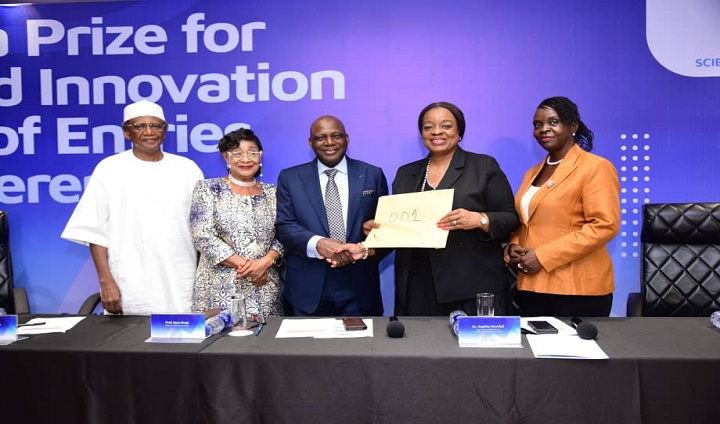
At the official handover of entries to the Advisory Board and panel of judges on Thursday, officials of Nigeria LNG Limited (NLNG) and members of the Advisory Board reaffirmed their commitment to maintaining the integrity, credibility, and global standard of the prestigious prize, even after the difficult decision not to announce a winner in the previous edition.
Speaking at the press conference, Dr. Sophia Horsfall, General Manager, External Relations and Sustainable Development at Nigeria LNG Limited, described digital infrastructure as indispensable to modern survival and economic sustainability, stressing that Nigeria must move beyond “promising research” to innovations capable of delivering measurable impact.
According to her, the decision not to declare a winner in 2025, despite receiving a then-record 112 entries, was one of the most difficult moments for both the Advisory Board and NLNG management. However, she said the organisers remained resolute in preserving the credibility of the prize by refusing to compromise standards.
“We believe that if a Nigerian discovery is to command global respect, it must withstand the highest levels of scrutiny,” she said.
Horsfall noted that rather than lowering expectations after last year’s outcome, NLNG chose to deepen engagement with researchers, innovators, academic institutions, innovation hubs, and the media through a nationwide roadshow and knowledge-sharing initiatives aimed at encouraging stronger and more competitive entries.
The effort, she said, has now yielded remarkable results. “This year, we have received 237 entries, surpassing the 112 entries received in 2025, making this the highest number in the history of the Prize,” she stated.
She added that the increase demonstrates a growing appetite among Nigerians for research, innovation, discovery, and recognition, while also reinforcing the importance of platforms that elevate scientific work and transform ideas into tangible impact.
Horsfall maintained that the credibility of the prize remains rooted in the quality of submissions and the integrity of its adjudication process. “A prize is only as valuable as the standards it upholds,” she remarked.
She also explained that the organisers retained this year’s theme — Innovations in Artificial Intelligence (AI) or Information Communication Technology (ICT) or Digital Technologies for Development — deliberately, because of its relevance to the defining technological realities of the present era.
In his remarks, Chairman of the Advisory Board and a former federal minister in Nigeria, Prof. Bart Nnaji, described the focus on AI, ICT, and digital technologies as “perhaps the most critical topic of our time,” emphasising that such innovations are central to socio-technical transformation and economic sustainability.
Drawing from his experience as an engineering professor, scientist, and entrepreneur, Nnaji said the technologies being spotlighted by the prize are not merely about gadgets or software, but represent practical tools for addressing national challenges and improving livelihoods.
Addressing last year’s controversial “no winner” verdict, he explained that the decision was never intended to diminish the efforts of Nigerian innovators, but rather to affirm the uncompromising standard of excellence associated with the prize.
“Our refusal to award the prize was not a dismissal of the hard work of Nigerian innovators. Rather, it was a statement that The Nigeria Prize for Science & Innovation holds a standard of excellence,” he said.
Nnaji expressed excitement over this year’s record-breaking participation, noting that the response from the Nigerian scientific community demonstrates that innovation in the country is thriving. “This year, we have beaten last year’s record, and all other records since the inception of the prize in 2004,” he announced.
According to him, the volume and quality of submissions suggest that more Nigerian researchers are moving beyond basic applications and are increasingly deploying sophisticated digital tools to tackle complex national problems.
He further provided insight into the adjudication process, revealing that the Advisory Board works closely with an independent panel of judges selected based on integrity and expertise across relevant fields.
“We provide you with our absolute assurance that this is a meticulous adjudication process. It is independent, unbiased, and strictly merit-based,” he said.
Nnaji stressed that the enduring credibility of the prize rests on consistency, fairness, balance, and equity in the selection process, adding that winners of the award earn global recognition because of the rigour involved in the assessment.
He explained that beyond recognising innovation, the broader goal of the prize is to identify solutions capable of delivering practical impact in areas such as healthcare, cultural preservation, language development, and broader socio-economic advancement.
He also commended NLNG for sustaining its investment in scientific excellence and innovation, saying the company continues to demonstrate that Nigeria can be an enabler, and not merely a consumer of technology.
With the formal handover completed, the Advisory Board and judges are expected to commence immediate review and assessment of the entries in what organisers described as a rigorous and highly detailed adjudication process.
Both Horsfall and Nnaji reiterated that the initiative underscores the importance of fundamental research as the foundation for national development and sustainable progress.