



The National Information Technology Development Agency (NITDA) has said its National Digital Literacy Framework remains the foundation of the Agency’s drive to equip children, students, artisans, farmers, professionals and other segments of society with the digital skills needed to participate effectively in Nigeria’s digital economy.
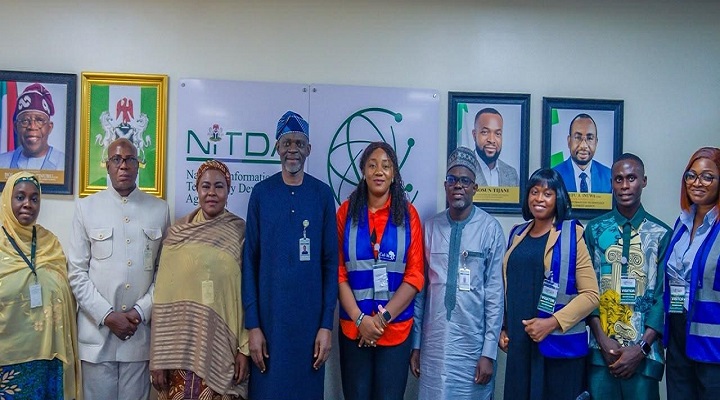
Director General of NITDA, Kashifu Inuwa, made this known during a courtesy visit by the Executive Director of Cal-Maji Foundation, Mrs Faith Ayuba, to the Agency’s headquarters in Abuja.
Represented by the Director of Digital Development Services, Mr Oluwunmi Oladejo, Inuwa explained that NITDA continues to monitor the performance of its intervention centres across the country while deploying emerging technologies to enhance digital learning and virtual capacity-building.
Responding to requests for additional support, the Director General disclosed that the Agency would consider training community-based instructors to sustain digital literacy programmes at the grassroots.
He encouraged the Foundation to submit a formal request, accompanied by evidence of activities at the centre, to facilitate further intervention.
Inuwa, however, observed that sustaining internet connectivity across numerous intervention centres nationwide remains a significant funding challenge requiring innovative solutions and collaboration.
The Director General reaffirmed NITDA’s commitment to expanding digital inclusion through strategic partnerships aimed at equipping underserved communities with digital skills and access to technology as part of efforts to accelerate Nigeria’s digital transformation.
He stressed that collaboration with community-based organisations remains central to NITDA’s vision of ensuring that no Nigerian is excluded from the opportunities presented by the digital economy.
According to him, the Foundation’s visit and positive feedback underscore the lasting impact of the Agency’s interventions across the country.
“It is always gratifying to receive feedback from communities that have benefited from our interventions. Many of these projects were implemented years ago, and it is rewarding to know they are still creating opportunities,” he said.
Earlier, Executive Director of Cal-Maji Foundation, Mrs Faith Ayuba, commended NITDA for its openness to partnerships and responsiveness to organisations committed to improving livelihoods in rural communities.
She described the Agency as one of the few government institutions that supports credible initiatives based on impact rather than personal connections.
According to her, the Foundation focuses on expanding access to education, strengthening food systems, improving food security and providing social protection for women and young people, particularly in hard-to-reach communities.
Ayuba revealed that NITDA’s Knowledge Access Centre established at the Foundation’s community school in a border community in Kogi State has transformed learning by providing students and residents with access to computers, internet services and digital education.
“The ICT centre became an equaliser. Young people who ordinarily would never have had access to computers or the internet suddenly had the opportunity to acquire digital knowledge. We came back simply to say thank you because this partnership has changed lives,” she said.
She disclosed that more than 1,000 children have benefited from the Foundation’s educational programmes and presented a former student who progressed from the community school to a Nigerian university after leveraging the digital resources available at the centre, describing his success as evidence of the initiative’s enduring impact.
Ayuba further appealed for deeper collaboration through the training of community instructors, upgrading of computer systems and increased access to NITDA’s digital capacity-building initiatives.
She emphasised that rural communities must not be left behind as Nigeria advances in emerging technologies such as artificial intelligence and cybersecurity.
The meeting concluded with both organisations reaffirming their shared commitment to expanding digital opportunities, empowering underserved communities and strengthening partnerships that support Nigeria’s inclusive digital economy agenda.