



News Highlights:
- NITDA has deployed AI-powered systems to automate document routing, workflow tracking, and improve institutional efficiency across its operations.
- The Agency says it is retraining staff for emerging AI-related roles while urging public institutions to adopt responsible AI governance with strong human accountability.
The Director General of the National Information Technology Development Agency (NITDA), Kashifu Inuwa, has revealed that the Agency has already deployed Artificial Intelligence-driven systems across its internal operations as part of a broader strategy to build a more efficient, accountable, and digitally resilient public institution.
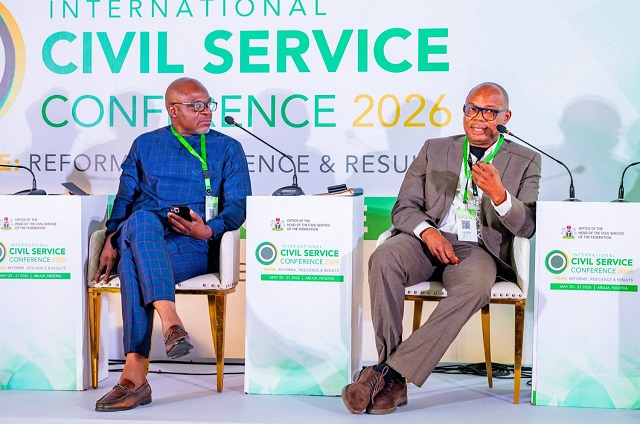
Speaking at the International Civil Service Conference 2026 held at Eagles Square, Abuja, the NITDA boss, represented by the Director of Stakeholder Management and Partnership, Dr. Aristotle Onumo, said the Agency is currently implementing a three-year AI Transformation Plan designed to guarantee institutional continuity, operational efficiency, and improved productivity.
According to him, the initiative is structured to ensure that government operations can continue seamlessly even when personnel changes occur.
“In NITDA as an agency, we have what we call the AI Transformation Plan. It is a kind of three-year plan which we have put in place so that even if the current staff is replaced completely, new personnel should be able to interact with the system and continue work without hindrance,” he stated.
Explaining how the system currently works within the Agency, the DG disclosed that official documents submitted at NITDA are now scanned immediately upon arrival and automatically routed by AI tools to the relevant departments and officers using keyword identification and subject classification technologies.
He further explained that the system also tracks response timelines and flags unattended correspondence where officers fail to act within approved deadlines.
“All that is required now is to drop documents at the gate. AI scans and routes them to the appropriate officers. If such documents are not treated within the required timeframe, the system flags them and reports accordingly,” he explained.
Despite growing concerns globally about the impact of AI on employment, the NITDA DG maintained that Artificial Intelligence should be seen as an enabler of productivity rather than a replacement for human capacity.
“There is always this fear that AI is coming to take away jobs, especially in the public service. But I want to state clearly that the jobs of people who refuse to upskill themselves may eventually be affected. However, those willing to retrain and adapt will benefit immensely from AI,” he said.
To prepare workers for the evolving digital environment, he disclosed that the Agency has commenced comprehensive AI training programmes for all categories of staff, while employees previously engaged in manual operations are now being reassigned into new technology-focused responsibilities.
“We have ensured that everyone undergoes AI training. Those who previously handled manual file operations have now been redesignated as AI assistants and AI administrators. We are preparing our workforce for the future rather than replacing them,” he noted.
While advocating increased AI adoption across government institutions, the NITDA boss stressed that human oversight and accountability must remain central to every AI implementation process.
“You must not take away human monitoring and accountability in any AI implementation process. At the end of the day, someone must remain accountable,” he cautioned.
He also urged Ministries, Departments, and Agencies (MDAs) to establish internal AI governance policies capable of defining operational limits, ethical standards, and accountability mechanisms for the technology.
According to him, AI deployment within government institutions carries greater responsibility than in the private sector because public institutions are directly accountable for policy failures, ethical breaches, and data misuse.
“We must ensure that whatever we use AI for aligns with data protection regulations and responsible use principles. Without proper frameworks, data misuse could become more prevalent and destructive,” he warned.
The DG further disclosed that NITDA is already leveraging the Agency itself as a practical AI sandbox to test implementation models ahead of wider deployment across Nigeria’s public service ecosystem.
He noted that the Agency’s efforts are aligned with the implementation of Nigeria’s National AI Strategy, which he described as one of the country’s most ambitious digital transformation policy frameworks.
As part of broader public sector digitalisation efforts, he said NITDA is collaborating with the Office of the Head of Civil Service of the Federation to train civil servants in digital literacy and AI-related competencies.
Reiterating the need for continuous learning in the emerging technology era, the NITDA boss warned that adaptability would determine workforce relevance in the years ahead.
“AI has not come to replace people completely. But those who refuse to develop their skills may struggle to fit into the evolving technology ecosystem,” he concluded.
