



The Director-General of the National Information Technology Development Agency (NITDA), Kashifu Inuwa, has called for a fundamental transformation of Nigeria’s education system, urging universities to prioritise practical skills, innovation and research commercialisation over the traditional emphasis on academic certificates.
Inuwa said Nigeria’s economic transformation would depend largely on its ability to convert scientific discoveries into marketable solutions, productive enterprises and improved public services, rather than merely producing research papers and awarding degrees.
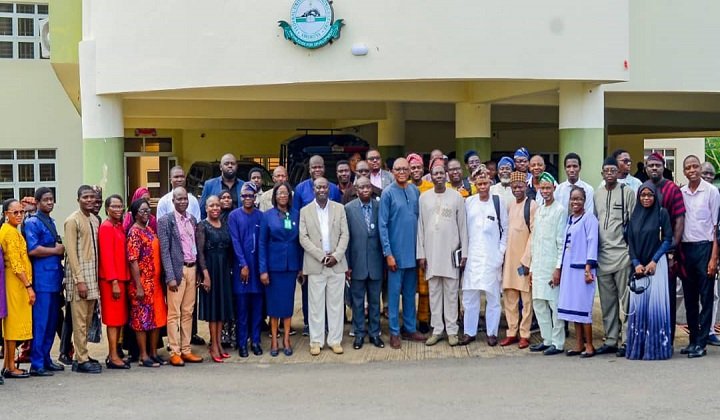
He made the call while delivering the keynote address at the 3rd International Biennial Conference of the College of Physical Sciences (COLPHYS 2026) at the Federal University of Agriculture, Abeokuta (FUNAAB), Ogun State.
Speaking on the theme, Inuwa, who was represented by the Director of NITDA’s Special Duties Department, Dr Aristotle Onumo, said, “From Scientific Discovery to National Prosperity: Harnessing Artificial Intelligence and Convergent Innovation to Transform Nigeria,” the NITDA chief urged universities to break down disciplinary barriers and embrace collaborative research, emerging technologies and practical problem-solving.
“The future of our country will not be determined simply by how much research we produce. It will be determined by how effectively we convert research into productivity, innovation, enterprise and national prosperity,” he stated.
Inuwa explained that artificial intelligence (AI) was creating opportunities for collaboration across agriculture, healthcare, environmental science, mathematics, engineering and data science, enabling researchers to address complex challenges through multidisciplinary approaches.
He stressed that AI should strengthen human expertise and scientific discovery rather than replace researchers or undermine human judgment.
“AI does not replace science. It amplifies science,” he said, emphasising that the value of technological advancement lies in its practical application to improve people’s lives.
Illustrating the potential of AI in agriculture, Inuwa said combining agricultural science with satellite imagery, climate modelling, Internet of Things sensors and AI could help farmers make better planting decisions, detect crop diseases, optimise irrigation, reduce waste and access improved market information.
He, however, cautioned that technology-driven solutions must reflect Nigeria’s realities, including local languages, affordability, limited connectivity and the specific needs of intended users.
He also identified opportunities for AI-enabled healthcare and climate resilience solutions, including disease surveillance, clinical decision support, flood-risk prediction and early-warning systems. Such applications, he maintained, must incorporate safeguards for data privacy, accountability, fairness and public trust.
The NITDA DG reaffirmed the agency’s commitment to strengthening Nigeria’s digital transformation through digital literacy, talent development, infrastructure expansion, innovation and responsible technology adoption.
He cited the agency’s Strategic Roadmap and Action Plan (SRAP 2.0), National Digital Literacy Framework (NDLF), Digital Literacy for All initiative (DL4ALL) and 3 Million Technical Talent (3MTT) programme as key interventions designed to equip Nigerians with skills for a technology-driven economy.
He further stressed the need for reliable connectivity, adequate computing resources, quality datasets, secure cloud environments and dependable electricity to enable research institutions to compete and develop locally relevant innovations.
According to him, stronger partnerships among government, academia, industry, investors and entrepreneurs are necessary to move promising research from the laboratory to the marketplace.
Turning to universities, Inuwa challenged institutional leaders to redefine academic success by placing greater emphasis on research impact, collaborative problem-solving, entrepreneurship and graduates’ capacity to create opportunities rather than merely seek employment.
“The University of the Future cannot remain merely a place where knowledge is transmitted, and certificates are awarded. It must become a place where problems are investigated, solutions are developed, enterprises are created, and society is transformed,” he said.
He urged universities to strengthen technology transfer mechanisms, build effective research-industry partnerships, expand entrepreneurship education and connect innovation hubs to market and community needs. Researchers, he added, should work towards transforming academic publications into functional prototypes, field-tested solutions and sustainable products or services.
Addressing students, the NITDA chief said academic qualifications remained important but needed to be complemented by digital and AI literacy, critical thinking, communication, teamwork, ethical judgment and practical problem-solving skills.
“Your certificate may open the door, but your capability will determine how far you go,” he remarked, encouraging students to use emerging technologies to investigate difficult questions and develop solutions to challenges in their communities.
To translate the conference’s deliberations into measurable outcomes, Inuwa proposed a 12-month innovation agenda for FUNAAB and its partners.
He urged COLPHYS to identify priority national challenges within 90 days, establish collaborative research teams and develop prototypes within six months, test promising solutions with communities and industry partners within nine months, and organise a research-to-impact showcase within 12 months.
He said progress should be measured through validated prototypes, effective partnerships, commercialisation opportunities and demonstrable societal benefits, rather than speeches and presentations alone. He also encouraged conference organisers to develop fundable collaborative research projects from the technical sessions and proposal-writing workshop.
Inuwa expressed NITDA’s readiness to explore structured collaborations with academic and research institutions in digital skills, responsible AI, indigenous innovation and practical applications of emerging technologies, stressing that successful partnerships must begin with clearly defined problems and credible implementation plans.
“Let this conference be remembered not merely as another gathering of brilliant minds, but as a turning point where we resolved to convert the power of science into the prosperity of our nation,” he concluded.
Earlier, the FUNAAB Vice-Chancellor, Professor Olusola Babatunde, represented by the Dean of the College of Environmental Resources Management, Professor Olusegun Oguntoke, commended NITDA for its contributions to Nigeria’s digital transformation.
He appealed to the agency to establish an Information Technology (IT) Hub at the university, saying the facility would strengthen digital capacity, support research and innovation, and provide students and researchers with an enabling environment to develop practical, technology-driven solutions.