



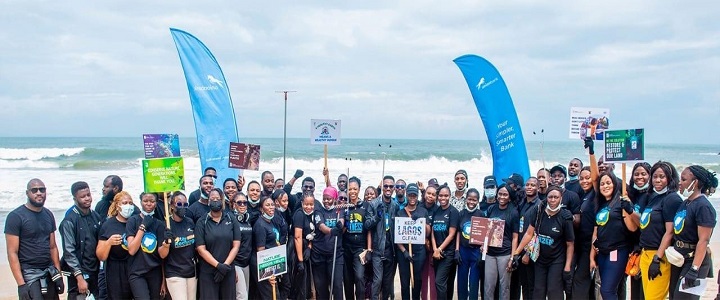
Union Bank of Nigeria has reinforced its environmental sustainability agenda by partnering with the Nigerian Conservation Foundation (NCF) to tackle plastic pollution through a beach cleanup exercise at Alpha Community Beach, Lekki, Lagos, on July 3, 2026.
The initiative reflects the Bank’s commitment to promoting a cleaner, healthier, and more sustainable environment while contributing to global efforts to combat plastic pollution and protect marine ecosystems.
The exercise comes at a time when Nigeria generates an estimated 2.5 million tonnes of plastic waste annually, with Lagos accounting for about 870,000 tonnes. More than 88 per cent of this waste is never recycled, with a substantial volume ending up in rivers, lagoons, and the ocean, threatening marine biodiversity and the livelihoods of coastal communities.
Against this backdrop, and in line with the United Nations Sustainable Development Goals (SDGs), particularly Goal 12 on Responsible Consumption and Production and Goal 14 on Life Below Water, Union Bank collaborated with the Nigerian Conservation Foundation to drive awareness and encourage collective action towards environmental preservation.
The cleanup was held to mark the Bank’s 2026 Employee Volunteer Day under its Employee Volunteering initiative, powered by UnionCares, its Corporate Social Responsibility proposition, with the event reinforcing Union Bank’s commitment to environmental stewardship, sustainable community development, and collective action for a cleaner future.
Bringing together more than 50 Union Bank employee volunteers, representatives of the Nigerian Conservation Foundation, and students from Rodan High School, Ajah, Lagos, the exercise embodied the spirit of SDG 17, Partnerships for the Goals, by uniting corporate, civil society, educational, and government stakeholders around a shared environmental purpose.
The Lagos State Government, through the Lagos Waste Management Authority (LAWMA), provided critical logistical support, ensuring that all collected waste was properly sorted and disposed of in line with environmental best practices.
Volunteers were organised into eight groups, collectively gathering in excess of 200 kilograms of waste from the beach, with additional waste recovered by participating individuals outside the groups. The collected waste was weighed at the end of the exercise to underscore the initiative’s measurable environmental impact.
Speaking at the commencement of the cleanup, the Bank’s Chief Brand and Marketing Officer, Mrs Olufunmilola Aluko, reaffirmed Union Bank’s commitment to environmental stewardship.
“At Union Bank, we understand that protecting the environment is a shared responsibility, and we are committed to playing our part. As the impact of climate change becomes more evident, initiatives like this allow our employees to take meaningful action, support cleaner communities, and contribute to a more sustainable future.”
Union Bank will continue to foster partnerships and community engagement that reflect its core values as a responsible corporate citizen and its commitment to making a positive and lasting impact in the communities it serves across Nigeria.
