



By Prof Ihechukwu Madubuike
Nigeria has entered that peculiar condition which development economists call growth without development, a condition which the British economist Dudley Seers, first Director of the Institute of Development Studies at Sussex and author of the 1969 classic ”The Meaning of Development”, said should be the final test of any economic claim.
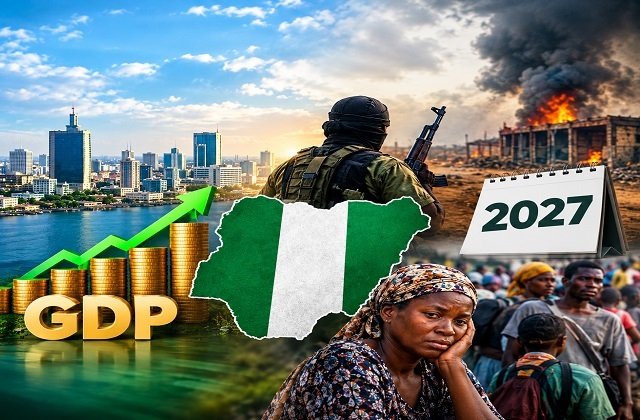
Seers insisted that we must ask what is happening to poverty, to unemployment and to inequality. If these three conditions have worsened, there is no development, even if Gross Domestic Product has doubled. Nigeria today answers Seers in the negative. GDP is rising. Poverty is rising faster.
The National Bureau of Statistics and the International Monetary Fund project a growth of three to four per cent for 2025 and 2026, driven by improved oil production, bank profits after foreign exchange unification, telecommunications and services.
This is the kind of growth that Robert Solow, the American economist at MIT and Nobel Laureate of 1987 who formalised modern growth theory in his 1956 paper, would describe as quantitative expansion without technological transformation.
It is growth on paper, not in capacity. Manufacturing capacity utilisation remains below fifty-five per cent, electricity available to the grid remains below five thousand megawatts for a projected over two hundred and thirty million people. There is also food inflation, which is the real inflation for the poor. It floats between thirty and forty per cent. The market woman in Onitsha Main Market and the farmer in Gboko do not experience this GDP. They experience the cost of diesel, the cost of transport, and the closure of markets.
This disconnection between GDP and welfare is compounded by insecurity, which is not an external shock but an economic product. Paul Collier, the Oxford economist known for his work ‘The Bottom Billion’, on why the poorest countries are trapped in cycles of war and poverty, argued that low income, slow growth and dependence on primary commodities create a conflict trap.
Nigeria fits his model. When the state is rentier, deriving over eighty per cent of foreign exchange from crude oil and distributing it through patronage, the young have no productive incorporation.
Peter Ekeh, the Nigerian political theorist trained at Columbia University who gave us the theory of the two publics in Africa in 1975, explains why. Ekeh argued that colonialism created two publics: the primordial public of kin, ethnicity, and religion, which commands moral loyalty, and the civic public of the state, which commands no moral legitimacy.
To loot the civic public is not immoral in the eyes of the primordial public. Thus, banditry in Zamfara, oil theft in the Delta, kidnapping on the Abuja-Kaduna road, and separatist enforcement in the South-East are not merely criminal; they are alternative economies of survival within the primordial public when the civic public has failed.
William Zartman, the American political scientist at Johns Hopkins University who pioneered studies on collapsed states, reminds us that state collapse is not when soldiers disappear, but when legitimate authority disintegrates.
Nigeria has deployed soldiers to almost every state, yet farms remain closed. In Benue and Plateau, the food basket, farmers cannot go to farm because of farmer-herder killings. When farms close, food supply drops, price rises, suffering deepens, and more youth are recruited into insecurity to survive. It is a closed loop. Macroeconomic stability cannot be endured without farm security, and farm security cannot be secured by barracks alone.
2027 is a matter of days. Nigerian economic crisis has become a political succession crisis. Claude Ake, the Nigerian political economist from the University of Port Harcourt, former President of CODESRIA and author of A Political Economy of Africa (1981), argued that the post-colonial state in Africa is not a developmental state but a state for primitive accumulation of wealth. Politics has been warfare by other means for control of the gate to oil rents. The elections are not policy contests but primordial censuses.
As we approach 2027, the risk is that the suffering population will be mobilised not around development but around identity — North versus South, Muslim versus Christian, old versus new — while the underlying structure remains Lugardian, designed in 1914 for extraction, not production.
Frantz Fanon, the Martiniquan psychiatrist and anti-colonial theorist who in The Wretched of the Earth, warned Africa that flag independence without economic decolonisation is merely Africanised colonialism. We have Africanised Lugard’s extraction state; we have not transformed it. (See my book, Nigeria and the Lugardian Hubris-Vision, Crisis And Prospects, 2012).
William Easterly, the American economist at New York University and former World Bank economist, in The Elusive Quest for Growth 2001, showed how IMF good policies produce growth blips without transformation, and Dani Rodrik, the Turkish economist at Harvard Kennedy School, who in his growth diagnostics of 2005, argued that macroeconomic stability without structural transformation is sterile.
Both point unarguably to Nigeria’s present situation. Leadership is celebrating dubious prices, an unstable unified exchange rate, the removal of a dysfunctional subsidy, and a narrow deficit while leaving binding constraints untouched: power, rail, industrial credit, moral legitimacy of the state, and, above all, security and welfare of the people.
Which way, Nigeria? Two futures present themselves.
The first is the future of accounting, namely to continue on the present path, announce rising GDP, borrow to sustain stability, deploy soldiers to enforce security across the country without adequate personnel or armaments, and go into 2027 with transactional politics where money is weaponised while suffering persists.
That future ends as previous cycles ended. That cycle is celebrated in Washington and endured in Nigeria, where existence is an absurdity.
The second is the future of transformation and freedoms. This path, which Amartya Sen, the Indian Harvard economist and Nobel Laureate of 1998, in Development as Freedom (1999) redefined development as expansion of freedoms to live a life that one has reason to value. Development is freedom from hunger and freedom from fear. It would secure farms before it secures GDP, decentralise power and policing, along Professor Ekeh’s civic public, which emphasises the moral principle, accountability and empathy.
Development invests in production, not just in stability. Development as freedom is making the 2027 election a contest of putting people first, of restructuring the polity, not just about rotation but in order to free it from the strictures of a colonial state. Even the opposition is silent on this important agenda of defining the substantive value of freedoms and people- first-oriented policy.
Rising GDP with insecurity and a suffering population is not progress. It is a warning that Nigeria must choose welfare over macroeconomic stability over the Bretton Woods economic enforcers.
**Prof. Ihechukwu Madubuike wrote from the Ihechukwu Madubuike Institute of Technology (IMIT), Nkwoagu, Amuda, Isuochi
