



The National Information Technology Development Agency (NITDA) and the Central Bank of Nigeria (CBN) have intensified efforts to protect Nigeria’s financial system from foreign digital disruptions through the implementation of the National Sovereign Cloud Initiative (NSCI) and data localisation.
The initiative aims to strengthen Nigeria’s control over critical digital infrastructure, protect sensitive financial data, reduce dependence on foreign-hosted technology services and ensure uninterrupted delivery of essential financial services.
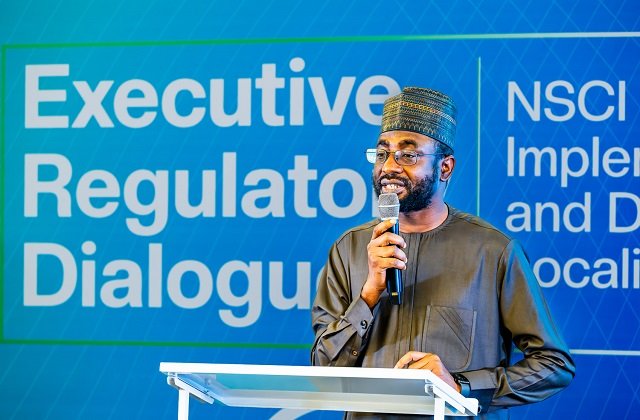
NITDA Director-General, Kashifu Inuwa, CCIE, disclosed this at an Executive Regulatory Dialogue organised by the Agency in partnership with the CBN in Lekki, Lagos State. The engagement brought together stakeholders from the financial services, telecommunications, data centre and technology sectors.
Inuwa warned that Nigeria’s increasing dependence on foreign-hosted digital infrastructure could expose its economy to serious risks in the event of geopolitical tensions or external disruptions.
He challenged stakeholders to consider the consequences of a situation in which Nigerian banks could no longer access critical digital infrastructure hosted outside the country.
“Imagine what will happen to our economy if tomorrow a major disruption or geopolitical crisis prevents our banks from accessing critical digital infrastructure hosted outside our country. Can our citizens still transfer money? Can businesses still receive payments? Can our banks keep processing transactions? Can our economy continue functioning?”
According to him, digital sovereignty is not merely a technological concern but a matter of national economic security, financial stability and the country’s ability to control its digital future.
He clarified that digital sovereignty should not be mistaken for technological isolation or an attempt to develop every technology locally.
“Digital sovereignty is not about politics. It is not about isolation. It is not about building everything ourselves, but it is about building our digital capacity to compete in the world we are today,” he stated.
Recalling the impact of the CBN’s cashless policy on Nigeria’s fintech ecosystem, Inuwa explained that the policy encouraged financial institutions to upgrade their technology infrastructure, creating opportunities for local fintech companies to develop innovative solutions.
He expressed confidence that the financial sector could once again lead the country’s digital transformation, noting that the NITDA-CBN partnership would make it the first sector to comply with the National Sovereign Cloud Initiative.
“Through this partnership, NITDA and CBN are working together to make sure the financial sector is the first sector to comply with our National Sovereign Cloud Initiative,” he stated.
Inuwa explained that NITDA would provide the standards and overarching policy framework, while sector-specific regulators would drive implementation within their industries.
He stressed that achieving digital sovereignty required collaboration among financial institutions, telecommunications operators, data centre providers, system integrators, technology companies and global cloud service providers.
Assuring stakeholders of Nigeria’s readiness, he maintained that the country was building on existing technological capabilities rather than starting from scratch.
“We have done it before, and we are going to do it now. So this is not something you can doubt; it is something that already exists,” he said.
He disclosed that an assurance framework would guide implementation, leveraging international certification standards while ensuring compliance with Nigeria’s national sovereign architecture requirements. The Agency is also exploring national certification options.
Identifying control, independence, resilience, risk management and freedom of choice as fundamental principles of digital sovereignty, Inuwa said Nigeria must develop the capacity to sustain essential services during external disruptions and avoid excessive dependence on individual technology vendors or jurisdictions.
Emphasising the importance of resilient infrastructure, he declared: “Submarine cable disruption cannot automatically affect our payment system.”
In his keynote address, the CBN Deputy Governor, Financial System Stability, Mr Lamido Abubakar Yuguda, reaffirmed the Bank’s commitment to strengthening financial stability, cybersecurity and the protection of critical financial data through the initiative.
Yuguda observed that the growing adoption of digital payments, fintech services, mobile money and digital banking had increased the financial sector’s dependence on digital infrastructure.
He urged financial institutions to strengthen cybersecurity, business continuity, disaster recovery and risk management arrangements while complying with applicable data localisation requirements.
He also highlighted January 1, 2027, as the implementation deadline for critical payment transaction data, urging financial institutions to prepare adequately.
The CBN Deputy Governor stressed that digital sovereignty should encourage innovation rather than isolate Nigeria from global technological developments.
“Our collective objective should be clear: to build a digital financial ecosystem that is innovative without compromising security, sovereign without becoming isolated and resilient enough to sustain public confidence,” he stated.
Meanwhile, the Special Assistant to the NITDA Director-General on Policy, Dr Muhammad Aminu Lawal, disclosed that a pre-event survey identified regulatory clarity, migration timelines and local infrastructure capacity as critical issues requiring attention ahead of the January 1, 2027 deadline.
Presenting the findings, Lawal said 79 per cent of the 42 digital infrastructure and service providers surveyed were ready to accommodate additional financial-sector workloads, while 74 per cent indicated they could onboard new financial customers within three months.
He, however, identified financing costs, electricity supply and foreign exchange challenges as major constraints, noting that much of the planned infrastructure expansion was expected in 2027.
The survey recommended clear regulatory guidelines, phased implementation milestones, a defined exceptions process and verifiable information on infrastructure providers capable of meeting the required standards.
Lawal said coordinated action by NITDA, the CBN and industry stakeholders would be necessary to address implementation uncertainties, strengthen local digital infrastructure and ensure a smooth transition to Nigeria-based data hosting and management.