



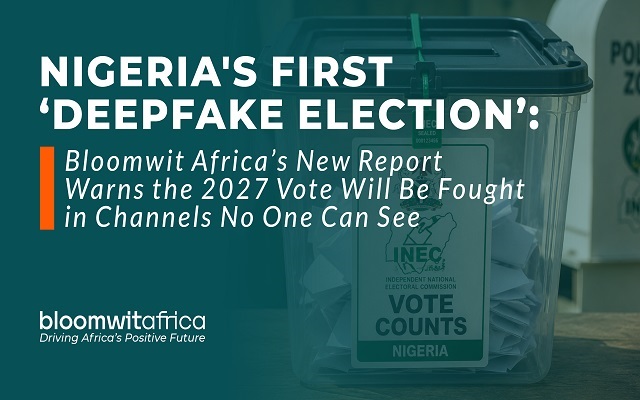
According to Navigating Nigeria 2027, a new strategic communications and reputation report by Bloomwit Africa, the 2027 general election will be the first in Nigeria’s history to be conducted at a time when generative AI tools are widely accessible and capable of significantly influencing the information ecosystem.
The report notes that the country’s digital landscape has already been reshaped, with fabricated audio recordings, videos, and images of prominent Nigerian public figures circulating online.
It adds that electoral and data protection authorities have identified AI-generated disinformation, deepfakes and politically targeted profiling as emerging threats capable of undermining the integrity of the electoral process.
Against this backdrop, the report urges businesses, investors and institutions to strengthen their crisis communication and digital risk management capabilities.
Its central message is clear: organisations should assume that highly convincing fake content involving their spokespersons, official statements or brands can be created at minimal cost and disseminated rapidly.
Consequently, they must invest in systems that can quickly detect, verify, and counter such fabrications before misinformation reaches its peak during the election cycle.
The Asymmetry that Defines the Year
The report frames 2027 around a single structural imbalance. The cost of fabricating a damaging association has collapsed, as generative tools make a convincing fake cheap and quick.
The cost of distributing it has collapsed too, as encrypted, high-trust networks carry it instantly. But the cost of detecting and correcting it has not fallen at all. Preparation, the report argues, is the only thing that closes that gap, and it cannot be improvised once the cycle is live.
Where the Conversation Actually Happens
The key indicators in the strategic communications and reputation management report include:
- 96.5% of Nigerian internet users are on WhatsApp, the highest platform penetration in the market, ahead of TikTok (89.7%) and Facebook and Instagram (89.2% each). Much of the country’s most consequential political conversation happens inside these closed, encrypted channels, maturing privately before it ever surfaces publicly.
- 8.1 platforms are used per person each month, with Nigerians spending an average of 29 hours a week on social media. A single screenshot can convert one private opinion into an apparent institutional position within hours.
- With 109 million internet users (about 45.5% of the population), Nigeria is a deeply multilingual market where stories often break in Hausa, Yoruba, or Igbo before they ever reach English.
The implication, the report argues, is that most organizations are “watching the wrong room.” A monitoring operation built solely around mainstream media and open social platforms overlooks encrypted groups, forwarded voice notes, and regional-language posts where damaging narratives actually form. “By the time a story reaches the outlets an organization monitors,” the report notes, “it has often already circulated for a day inside the channels it does not.”
Commenting on the new report, Oti Egwu, Bloomwit Africa’s Executive Director, said: The danger in 2027 isn’t that fabrications exist; it’s the gap between the moment a lie starts spreading and the moment you discover it. That gap used to be hours. AI and encrypted networks have reduced it to minutes. Most organizations in Nigeria are still planning in hours.
“You cannot stop fabrications from being made. That ship has sailed. What you can do is prepare ahead of the election: know where the conversation really happens, in every language it happens in, and be ready to respond before a lie hardens into fact. Preparation is the whole game now.”
A New Standard for Readiness
The report sets a benchmark it calls the Bloomwit Africa Monitoring Standard: an organization’s monitoring should detect a developing story and brief its response team within the hour, in any relevant language, including the closed channels where it starts. If it cannot, the report warns, “you are operating blind precisely when sight matters most.”
It recommends organizations pre-prepare a synthetic-media denial protocol deployable across platforms simultaneously and build authentic communications so consistent that fabricated content reads as off-brand, and therefore suspect.
The stakes are high because trust in Nigeria is high. The country ranks 4th of 28 markets on the 2026 Edelman Trust Index — an asset the report calls both an advantage and an exposure: “the markets that give the most trust punish its betrayal the hardest, and an election year is when betrayal is easiest to manufacture and fastest to spread.”
With the presidential poll brought forward to 16 January 2027, the earliest since 1999, the preparation window is shorter than the headline date suggests.
The report can be downloaded here.